

Why Online Badminton Booking Software Is a Must for Clubs in 2026
Discover why online badminton booking software has become essential for modern clubs. Learn how real-time reservations, mobile booking, integrated payments, and automated reminders improve the player experience while reducing administrative work.
Badminton clubs are getting harder to run with phone calls, spreadsheets, and handwritten calendars.
Players expect to see open courts, book from their phones, pay online, and receive confirmation without waiting for staff. At the same time, club owners need to manage cancellations, memberships, recurring reservations, coaching sessions, and court utilization.
Online badminton booking software brings those tasks into one system. It gives players an easier way to book while reducing the administrative work behind every reservation.
For clubs still relying on manual scheduling, moving online is becoming less of a convenience and more of an operational necessity.
What Is Online Badminton Booking Software?
Online badminton booking software lets players view court availability and make reservations through a website or mobile device.
For the club, the software maintains the schedule and connects bookings with other parts of the operation.
A complete system may handle:
| Feature | What it does |
|---|---|
| Real-time availability | Shows players which courts and times are open |
| Online reservations | Lets players book without contacting staff |
| Payments | Collects fees during or after booking |
| Recurring bookings | Handles regular weekly groups or coaching sessions |
| Memberships | Applies member rates, benefits, and booking rules |
| Notifications | Sends confirmations, reminders, and schedule changes |
| Cancellation rules | Helps manage late cancellations and no-shows |
| Reporting | Shows booking patterns and court utilization |
The biggest difference is simple: the reservation process no longer depends on someone being at the front desk.
Why Manual Booking Becomes A Problem
Manual scheduling can work when a club is small.
But every additional court, member, coach, and program adds another layer to the schedule.
Staff spend time answering routine questions
A player calls:
“Do you have a court available at 7?” Staff check the schedule. The player asks about 7:30 instead. Then they call back to cancel.
Multiply that process across dozens or hundreds of players and a basic booking question becomes a significant administrative task.
Self-service booking removes much of that back-and-forth.
Double bookings become easier to make
Separate calendars, spreadsheets, and staff members can create conflicting information.
Good online scheduling software should update availability as reservations are made, reducing the chance that two players are promised the same court.
For more on scheduling rules, see Badminton Court Scheduling Best Practices.
Changes are harder to communicate
A cancellation, coaching change, or court closure can require multiple calls or messages when everything is handled manually.
Automated notifications make it easier to keep players informed.
7 Reasons Badminton Clubs Need Online Booking Software
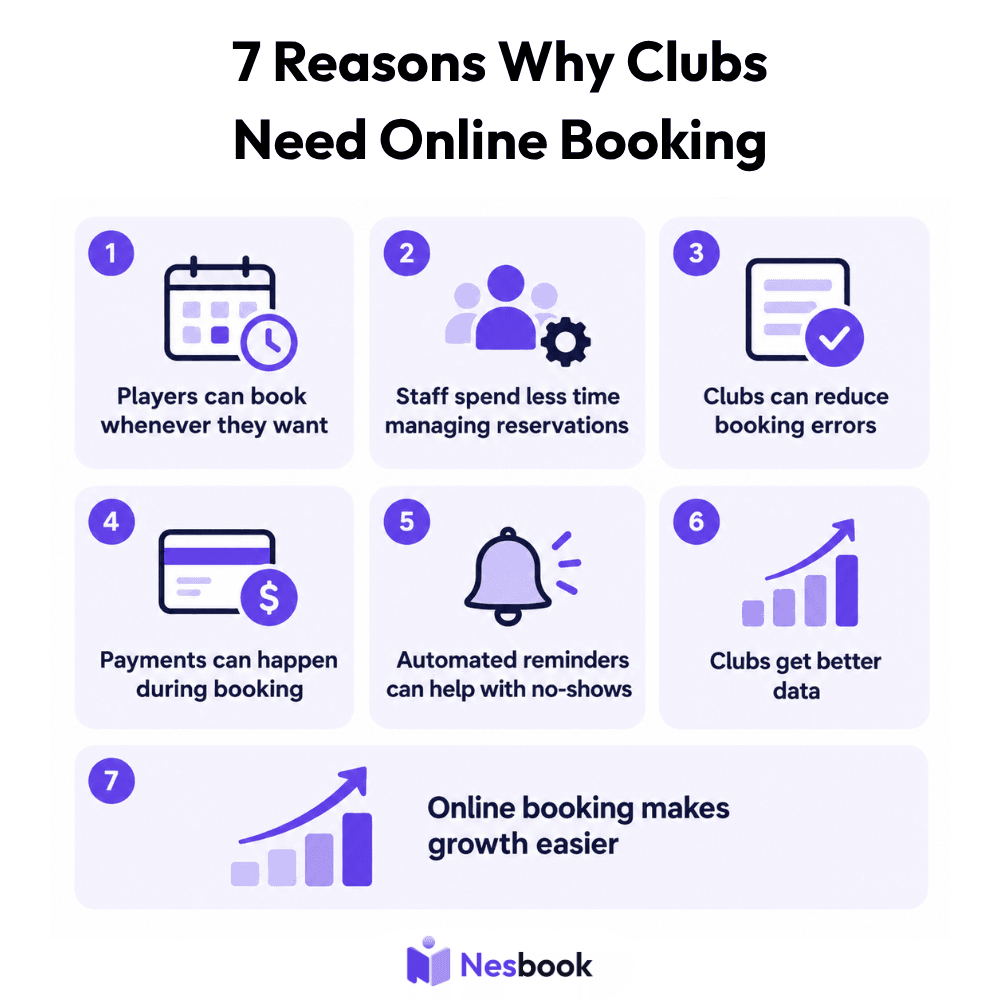
1. Players can book whenever they want
A booking system does not close when the front desk does.
Players can check availability before work, late at night, or while making plans with friends.
That convenience removes one step between wanting to play and actually reserving a court.
2. Staff spend less time managing reservations
Every reservation completed without staff involvement saves administrative time.
That gives employees more time for:
- Customer service
- Facility maintenance
- Coaching programs
- Events
- Member support
The point isn’t eliminating staff. It’s reducing repetitive work.
3. Clubs can reduce booking errors
Online systems maintain one shared schedule.
That helps prevent situations where a court is booked through one channel but still appears available somewhere else.
Clear scheduling rules are especially important for recurring bookings and peak-hour demand.
Learn more about reducing scheduling conflicts and managing recurring reservations in Badminton Court Scheduling Best Practices.
4. Payments can happen during booking
A reservation is more valuable when the payment process is connected to it.
Online payments can reduce:
- Unpaid reservations
- Front-desk collections
- Manual payment records
- Follow-up messages
They can also make cancellation and refund policies easier to apply consistently.
5. Automated reminders can help with no-shows
An unused reserved court represents lost capacity.
Booking confirmations and reminders give players another opportunity to remember, modify, or cancel a reservation.
Clubs can then combine notifications with clear cancellation policies or waitlists.
6. Clubs get better data
Paper calendars tell you who booked a court.
Modern booking systems can help answer more useful questions:
- Which hours are busiest?
- Which courts are underused?
- When do cancellations happen?
- Which customers book repeatedly?
- Are weekday mornings consistently empty?
- Are memberships generating more bookings?
That information can support smarter pricing and programming decisions.
Nesbook’s court-utilization guidance recommends breaking occupancy down by time, court, booking type, customer group, and other factors rather than relying only on an overall utilization figure.
7. Online booking makes growth easier
Managing four courts manually is one thing.
Managing twelve courts, several coaches, different membership plans, and two locations is another.
The more complicated the facility becomes, the more valuable centralized scheduling and customer information become.
Learn more about growing club revenue in 12 Ways to Increase Revenue at Your Badminton Club.
Online Booking Can Improve Court Utilization
A busy Friday night can make a club feel successful.
That doesn’t necessarily mean the facility is using its capacity well.
Consider this example:
| Time period | Available court hours | Booked hours | Utilization |
|---|---|---|---|
| Weekday mornings | 80 | 28 | 35% |
| Weekday afternoons | 80 | 40 | 50% |
| Weekday evenings | 80 | 74 | 93% |
| Weekends | 100 | 76 | 76% |
The opportunity is obvious.
Discounting already-full evening courts would accomplish little. Filling weekday mornings could generate additional revenue without adding another court.
Nesbook defines court utilization as booked court hours divided by available sellable court hours and recommends examining utilization by time period rather than relying on one facility-wide number.
Make empty courts easier to discover
Online availability lets players see openings they may never have known existed.
A customer looking for Tuesday at 7 p.m. may discover that Tuesday at 5 p.m. is open instead.
Use recurring bookings to create predictable demand
Recurring reservations work well for:
- Weekly groups
- Coaches
- Schools
- Junior programs
- Leagues
- Corporate teams
They can provide predictable utilization and reduce repetitive booking work.
Consider peak and off-peak pricing
Demand isn’t equal throughout the day.
Different pricing for busy and quiet periods can help shift some customers toward underused slots.
Nesbook’s dynamic-pricing guide recommends using pricing to reflect demand rather than simply applying blanket discounts.
Online Booking Should Connect With Memberships
Members shouldn’t have to use one system for membership and another for court reservations.
Ideally, the booking platform recognizes:
- Membership status
- Member pricing
- Booking privileges
- Renewal dates
- Included benefits
- Available credits
As clubs grow, managing these details manually becomes increasingly difficult. Connecting membership data with bookings, payments, communication, and scheduling helps keep the entire customer experience in one place.
Read Badminton Membership Management Software: Complete Guide for more detail.
What Should Clubs Look For In An Online Booking System?
Make mobile booking easy
Most players shouldn’t need instructions to reserve a court.
Test the process yourself.
Can a new customer:
- Find an available court?
- Select a time?
- Create an account?
- Pay?
- Receive confirmation?
If those steps are frustrating, the booking system is creating friction instead of removing it.
Look beyond the calendar
A calendar is only one part of running a badminton facility.
Growing clubs may also need:
- Membership management
- Payments
- Coaching schedules
- Customer records
- Recurring bookings
- Multi-court management
- Reporting
- Staff permissions
Choose a platform that can grow
Switching systems later means moving customer information, retraining staff, and changing the booking experience for players.
Think about where the club may be in two or three years, not only what it needs today.
Why Nesbook Is The Right Choice
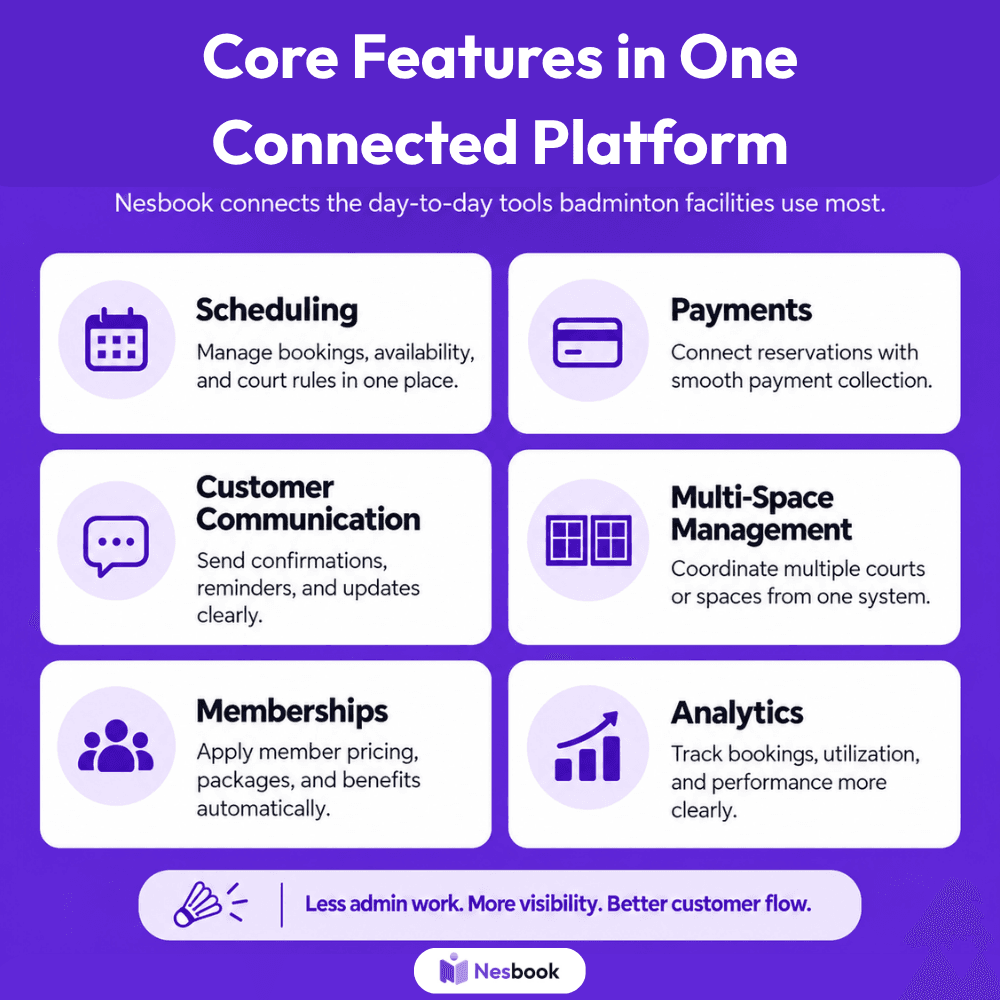
Nesbook is designed to connect online booking with the wider operation of a badminton facility.
Rather than treating court reservations as a standalone calendar, the platform combines booking with functions such as scheduling, payments, customer communication, multi-space management, and analytics.
That makes it particularly relevant for clubs that want to reduce administrative work while gaining a clearer view of how their courts are being used.
Is Online Badminton Booking Software Worth It?
For a very small club with only occasional reservations, manual scheduling may still work.
But once staff are spending substantial time answering booking questions, chasing payments, managing cancellations, or correcting schedule conflicts, the cost of doing everything manually becomes harder to ignore.
Online booking software gives players more control while giving facility owners better visibility.
The goal isn’t simply to put a calendar on a website.
It’s to make booking courts easier for players and running the club easier for staff.
Ready To Move Your Badminton Bookings Online?
Ready To Move Your Badminton Bookings Online?
Nesbook helps badminton facilities manage bookings, scheduling, payments, customer communication, and court operations from one system.