
How to Improve Court Utilization at Your Badminton Club
Learn how to improve badminton court utilization by measuring occupancy, reducing booking friction, managing peak demand, and filling underused time slots.
A full court makes money.
An empty court does not.
That sounds obvious, but many badminton facilities focus on total bookings without looking closely at:
- when courts sit empty,
- which time slots fill fastest,
- and which customers are using them.
Court utilization gives you a clearer picture.
Instead of simply asking, “Are we busy?” you can ask:
- Which hours are consistently full?
- Which courts are underused?
- When do cancellations happen?
- Which programs create repeat demand?
- Where can we add revenue without adding more courts?
Improving badminton court utilization is not about filling every available hour at any cost. It is about using your existing court capacity more efficiently.
What Is Badminton Court Utilization?
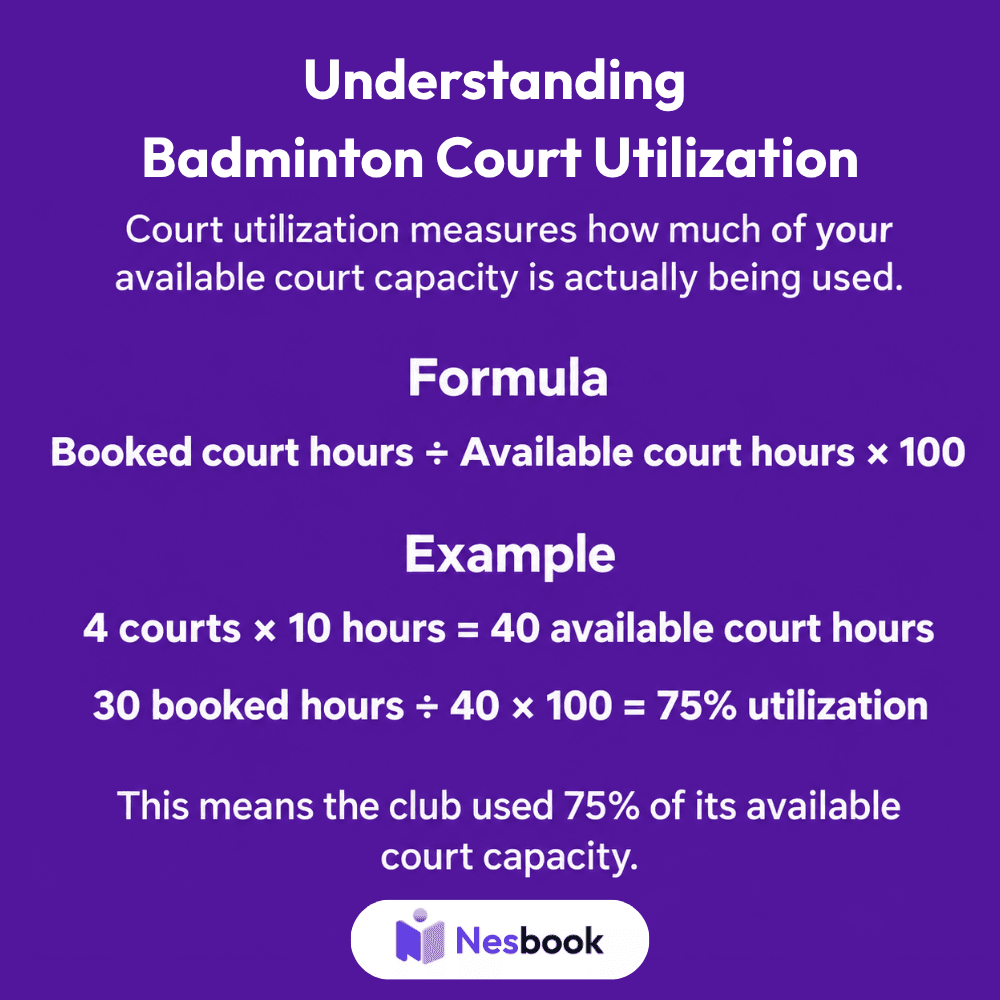
Court utilization measures how much of your available court capacity is actually being used.
A simple formula is:
Court utilization = Booked court hours ÷ Available court hours × 100
Why Overall Utilization Can Be Misleading
Imagine your club reports 70% utilization for the week.
That sounds healthy.
Then you break the number down by time.
| Time period | Available hours | Booked hours | Utilization |
|---|---|---|---|
| Weekday mornings | 80 | 24 | 30% |
| Weekday afternoons | 80 | 40 | 50% |
| Weekday evenings | 80 | 76 | 95% |
| Weekends | 100 | 82 | 82% |
Now the problem is much easier to see.
The club does not necessarily need more courts.
It needs more demand during weekday mornings and afternoons.
That distinction matters because building or leasing additional court space is expensive.
Improving the use of capacity you already have can be much cheaper.
Track Utilization By Time Period
Start by separating bookings into meaningful time blocks.
For example:
- Early morning
- Weekday morning
- Weekday afternoon
- Weekday evening
- Weekend morning
- Weekend afternoon
- Weekend evening
You may discover that certain periods are nearly impossible to book while others sell out days ahead.
Those patterns should influence pricing, programming, memberships, and marketing.
Identify Your Peak And Off-Peak Hours
Most badminton facilities have predictable high-demand periods.
These often include evenings and weekends.
The problem comes when facilities treat every hour the same.
A court at 7 p.m. on Friday may have considerably more demand than that same court at 11 a.m. on Tuesday.
That creates an opportunity to use different strategies for each period.
During peak hours
Focus on:
- Efficient scheduling
- Cancellation rules
- Waitlists
- Shorter booking gaps
- Premium pricing where appropriate
- Making sure courts do not sit unused after late cancellations
During off-peak hours
Focus on:
- Promotions
- Coaching
- School programs
- Senior programs
- Corporate groups
- Recurring bookings
- Leagues
- Discounted memberships
- Off-peak pricing
The objective is not to discount everything.
It is to create demand where capacity already exists.
Use Off-Peak Pricing Strategically
Suppose a court costs $40 per hour throughout the day.
At 7 p.m., the court is almost always booked.
At 1 p.m., it sits empty most days.
Reducing the 7 p.m. rate would probably sacrifice revenue.
Offering a more attractive rate at 1 p.m. may generate a booking that would not otherwise happen.
For example:
| Time | Standard rate | Possible strategy |
|---|---|---|
| 9 a.m.–3 p.m. | $40 | $28–$32 off-peak rate |
| 3 p.m.–5 p.m. | $40 | Standard rate |
| 5 p.m.–9 p.m. | $40 | Standard or peak rate |
| Late evening | $40 | Test reduced rate if demand falls |
The exact prices will depend on the market.
The important point is to price according to demand rather than assuming every hour has the same value.
See How to Reduce No-Shows at Your Badminton Club for more ways to protect valuable court time.
Encourage Recurring Bookings
Recurring reservations can improve utilization because they turn uncertain demand into predictable demand.
Examples include:
- Weekly recreational groups
- School teams
- Coaches
- Junior programs
- Corporate groups
- Adult leagues
- Clubs
- Tournament practice groups
Imagine a coach reserves two courts every Tuesday and Thursday from 2 p.m. to 4 p.m.
That creates:
4 court hours per day × 2 days = 8 booked court hours per week
Over 40 weeks, that becomes:
320 court hours
A single recurring customer can therefore fill a meaningful amount of otherwise underused capacity.
Build Programs Around Empty Time Slots
Sometimes customers will not book an unpopular period simply because it is cheaper.
You may need to give them a reason to come.
Junior programs
After-school programs can fill afternoon courts before adult demand peaks.
Senior badminton
Retired players may have more schedule flexibility and can help fill weekday mornings.
Corporate programs
Businesses may use courts for:
- Employee wellness
- Team-building
- Recreation leagues
- Company events
Beginner clinics
Introductory programs can attract customers who are not ready to reserve courts independently.
Coaching programs
Coaches create structured demand and may bring the same players back every week.
Instead of waiting for individual customers to discover empty court time, the facility creates a product around it.
Reduce No-Shows And Late Cancellations
A court can technically be booked and still generate poor utilization.
Consider this example:
A customer reserves Court 3 from 6 p.m. to 7 p.m. They never arrive. Your system shows the court as booked. Operationally, however, the court sat empty during one of the facility’s most valuable hours.
That is why facilities should track:
- No-shows
- Late cancellations
- Cancellation timing
- Repeat offenders
- Lost peak-hour capacity
Use booking reminders
Automated reminders can give customers time to cancel before the reservation begins.
Set clear cancellation rules
Policies might include:
- Free cancellation until a set deadline
- Partial charges for late cancellations
- Full charges for no-shows
- Different rules for peak and off-peak reservations
The goal is not punishing customers.
It is giving the facility enough time to resell valuable court time.
Use Waitlists During Busy Periods
A waitlist can turn cancellations into new bookings.
Without one:
7 p.m. booking cancels → court stays empty
With one:
7 p.m. booking cancels → waitlisted player gets notification → court is rebooked
This is especially useful during high-demand evenings and weekends.
The process should be automated whenever possible so staff do not have to call customers manually.
Eliminate Unnecessary Gaps Between Bookings
Small scheduling gaps can quietly reduce capacity.
Suppose your courts are booked like this:
- 5:00–6:00
- 6:15–7:15
- 7:30–8:30
Those two 15-minute gaps create 30 minutes of unusable court time.
Across eight courts, that becomes:
30 minutes × 8 = 4 lost court hours
If that happens five days per week:
20 court hours disappear every week.
Standardized booking intervals can reduce those gaps.
For example:
- 60-minute reservations
- 90-minute reservations
- Reservations beginning every half hour
- Fixed turnover periods only when necessary
Look for patterns in your schedule where small gaps repeatedly prevent another reservation.
Make Court Availability Easy To See
Players cannot book courts they do not know are available.
A customer may assume Friday night is completely full.
If your booking system shows live availability, they may discover an opening at 8:30.
They might also see:
“7 p.m. unavailable. 6 p.m. and 8:30 p.m. available.”
That gives the customer alternatives without requiring a phone call.
Online badminton booking software can therefore support utilization simply by making unused capacity easier to find.
Example: Off-Peak Membership
Members receive discounted court access:
Monday–Friday, 9 a.m.–4 p.m.
The member gets a lower price.
The facility gains customers during periods that would otherwise remain empty.
Example: Premium Membership
Members receive:
- Advanced booking windows
- Peak-hour access
- Included reservations
- Priority waitlists
Different membership levels allow clubs to manage demand while giving customers clear benefits.
Measure Utilization By Booking Type
Not every reservation generates the same value.
Separate bookings into categories such as:
- Casual rentals
- Members
- Coaching
- Leagues
- Tournaments
- Junior programs
- Corporate events
You may discover that coaching occupies 20% of court hours but produces significantly more revenue than casual bookings.
Or you may find that memberships generate excellent retention but concentrate too much demand during peak periods.
Looking at booking type gives more context than utilization alone.
Measure Revenue Per Available Court Hour
Utilization tells you whether courts are being used.
Revenue tells you whether that use is financially productive.
One useful metric is:
Revenue per available court hour
Suppose two clubs each have 80% utilization.
Club A
Average revenue per booked court hour: $25
Club B
Average revenue per booked court hour: $42
Their utilization is identical.
Their financial performance is not.
That is why utilization should be reviewed alongside:
- Revenue
- Pricing
- Membership revenue
- Coaching revenue
- Discounts
- Peak vs. off-peak activity
Learn more about the numbers behind court performance in Revenue Analytics Every Badminton Club Should Track.
Example: Improving Utilization Without Adding Courts
Imagine a six-court badminton center.
Management considers leasing space for two additional courts because evenings constantly sell out.
Before expanding, the owner reviews utilization.
They discover:
- Evening utilization: 97%
- Weekend utilization: 91%
- Afternoon utilization: 49%
- Morning utilization: 31%
Instead of immediately adding courts, the club launches:
- Morning senior programs
- Afternoon junior coaching
- Corporate packages
- Off-peak memberships
- Recurring reservations
- Automated waitlists for peak hours
Six months later, morning and afternoon utilization improves substantially.
The club increases revenue without adding physical capacity.
That is the power of utilization data.
Which Metrics Should Badminton Clubs Track and Why It Matters?
At minimum, review:
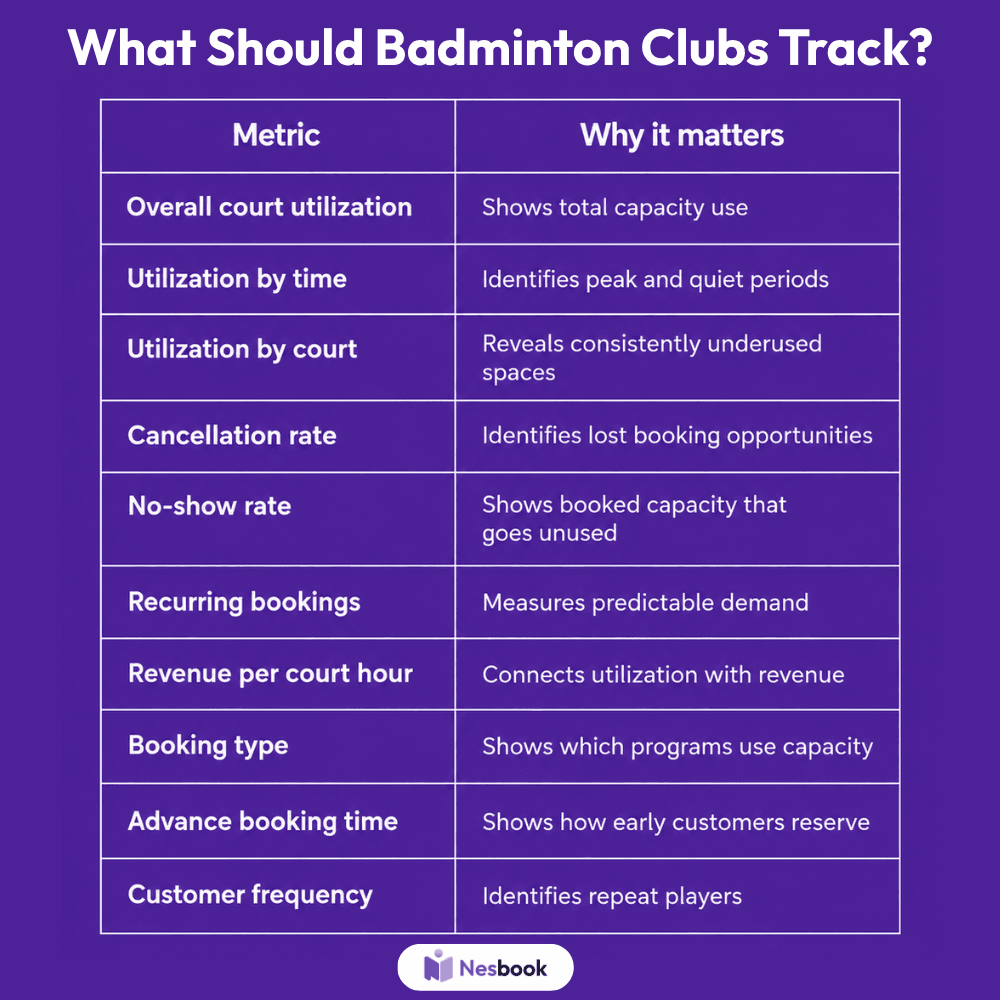
These numbers should guide decisions rather than simply appearing in a monthly report.
How Booking Software Can Improve Court Utilization
Manually calculating all of this from calendars and spreadsheets is possible.
It is also time-consuming.
A facility-management platform can connect:
Reservations → customers → payments → memberships → court usage → reporting
That makes it much easier to identify patterns.
Nesbook is designed to help facilities manage bookings and court operations while giving owners greater visibility into how their spaces are being used.
Instead of guessing when demand is weak, owners can make decisions based on actual booking activity.
How Often Should You Review Utilization?
Don’t wait until the end of the year.
A useful schedule might be:
Weekly
Review:
- Empty peak slots
- Cancellations
- No-shows
- Unusual booking patterns
Monthly
Review:
- Utilization by time
- Revenue per court hour
- Program performance
- Membership activity
Quarterly
Make larger decisions about:
- Pricing
- Programs
- Operating hours
- Marketing
- Membership plans
- Court expansion
That turns utilization from a statistic into a management tool.
How Can You Improve Badminton Court Utilization?
Start with the simplest question:
When are your courts empty?
Then determine why. Here are some starting points to consider:
- Maybe customers do not know those hours are available.
- Maybe prices do not match demand.
- Maybe your programs target the wrong times.
- Maybe late cancellations are creating empty peak-hour courts.
- Maybe the club needs more recurring groups rather than more individual reservations.
Improving utilization usually comes from several small changes rather than one major fix.
The goal is to make better use of the courts you already have before paying for more capacity.
Ready To Get More From Your Existing Courts?
Manage Your Badminton Facility in One Place
Nesbook helps badminton facilities manage reservations, scheduling, payments, customers, and court activity from one place. Get better visibility into how your courts are being used so you can make more informed decisions about pricing, programming, memberships, and growth.