
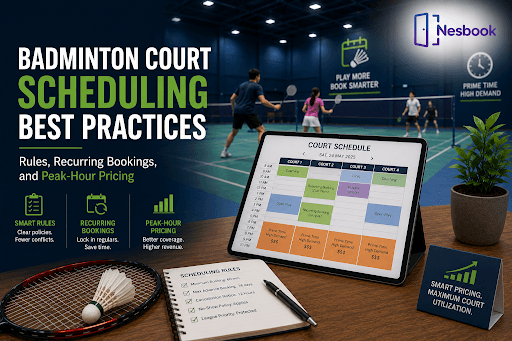
Badminton Court Scheduling Best Practices: Rules, Recurring Bookings, and Peak-Hour Pricing
Learn badminton court scheduling best practices to prevent double bookings, optimize court availability, manage recurring bookings, and maximize court utilization.
Good court scheduling is mostly invisible when it's working — players book, show up, and play without friction. It only becomes visible when it breaks: a double-booking, a recurring slot that got overwritten, a peak evening that's somehow both overbooked and under-monetized. This piece covers the scheduling practices that keep it invisible, and connects with the operational realities of running several courts at once and the fuller facility management picture.
Setting Scheduling Rules Before You Need Them
Most scheduling problems are easier to prevent with a clear rule than to resolve after the fact once a conflict or complaint has already happened. A few rules worth deciding on deliberately, rather than figuring out reactively the first time they cause a problem:
| Rule | What It Prevents |
|---|---|
| Minimum booking increment (e.g. 30 or 60 minutes) | Fragmented, hard-to-fill gaps between sessions. |
| Maximum advance booking window | Courts being held far in advance by bookings that may not materialize. |
| Cancellation notice period | Last-minute cancellations that can't be resold to another player. |
| Recurring booking cap per player | One player or group quietly monopolizing prime evening slots. |
None of these rules need to be rigid forever — they can be adjusted as a facility learns more about its own booking patterns. What matters is having a default in place before the busiest night of the month forces a decision on the fly.
Why Real Availability Is Harder Than It Looks
A court's availability isn't just whether it's booked right now — it's whether every booking channel agrees on that status at the same moment. The operational challenges of running multiple courts cover this in more depth, but the short version is that availability only means something if it updates everywhere instantly. A court that shows open in the app but booked at the front desk isn't a minor glitch — it's the exact condition that produces a double-booking.
Recurring Bookings: Treating Regulars as a Structural Part of the Calendar
Standing weekly slots for leagues, regular players, and coaching sessions behave differently from one-off bookings and need to be treated that way in the scheduling system. A recurring booking that has to be manually re-entered every week isn't just extra admin work — it's a recurring opportunity for someone to accidentally release that slot to a different booking.
It also helps to periodically review recurring bookings against actual attendance. A standing slot that's been booked for months but rarely used ties up prime court time that could go to someone actually playing — worth a light-touch check every so often rather than letting a recurring booking run indefinitely on autopilot.
Communicating any changes to a recurring booking clearly and early matters more than it might seem. A regular player or league that loses a long-standing slot with little notice tends to feel that far more acutely than a one-off booking being moved, since the expectation of consistency is really the whole point of booking recurring time in the first place.
Buffer Times: The Slack That Keeps a Schedule Recoverable
A zero-gap schedule looks efficient on paper but tends to fall apart the first time a session runs a few minutes long. Buffer time between bookings isn't wasted capacity — it's what absorbs the small, inevitable delays that would otherwise cascade into every booking scheduled afterward. This is really the same principle covered in more depth when looking at capacity planning across multiple courts: a schedule with zero slack is fragile, even if it looks fully booked.
Buffer length doesn't need to be identical across every court or every time slot. A court used mainly for quick casual sessions can usually run a shorter buffer than one used for coaching, where equipment setup and teardown genuinely take longer between bookings.
Peak-Hour Pricing: What Hospitality Research Says About Doing It Fairly
Charging more for evening and weekend slots is common and generally reasonable, but hospitality revenue management research from Cornell's Center for Hospitality Research has specifically studied how customers perceive demand-based pricing fairness in booking-driven businesses like hotels and restaurants. The consistent finding is that customers accept peak pricing far more readily when it's transparent and consistent than when it feels arbitrary or is only revealed at checkout. For a badminton facility, that means publishing peak-hour rates clearly upfront tends to generate far less pushback than quietly varying prices without explanation.
Peak pricing also interacts directly with deposits and cancellation policy — how deposits are structured matters more during peak hours specifically, since a no-show on a Tuesday morning is a very different cost than one on a Saturday evening.
Using Data to Actually Know What Peak Hours Are
It's easy to assume which hours are busiest based on general impression rather than checking. Regular reporting on court utilization and booking trends is the more reliable way to confirm which slots genuinely warrant peak pricing or extra buffer time, rather than applying rules uniformly based on assumption. Facilities that periodically check this data tend to find their pricing and staffing decisions were slightly off from what the numbers actually show.
FAQs
How far in advance should players be able to book a court?
There's no universal answer, but most facilities settle somewhere between two and four weeks. Too short frustrates regular players planning ahead; too long risks courts being held by bookings that may not materialize, particularly without a deposit attached.
Should peak-hour pricing be the same across every court?
Not necessarily. Courts with different typical uses — casual play versus coaching or league matches — may reasonably carry different pricing even during the same peak hours, depending on actual demand for each.
How often should scheduling rules be reviewed?
Every few months is usually enough for most facilities, or sooner if a specific rule is generating repeated complaints or clearly isn't matching actual booking behavior. Rules set once and never revisited tend to drift out of step with how a facility actually operates as it grows.