
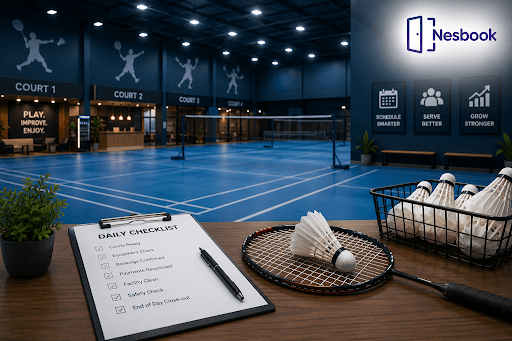
Complete Guide to Managing a Badminton Facility
Learn how to manage a badminton facility efficiently with practical guidance on daily operations, staffing, memberships, payments, reporting, and long-term growth.
Running a badminton facility well is less about any single big decision and more about a long list of small ones, repeated correctly every day. Courts open on time, staff know what they're doing, players get a consistent experience, and the money coming in actually gets tracked. None of it is complicated in isolation, but it adds up fast once a facility has more than one court and more than a couple of staff on the schedule. This guide covers the core areas that determine whether a facility runs smoothly or constantly firefights the same problems — and where a more complete look at the software side of facility management fits in if you're evaluating tools to help with any of it.
Daily Operations
The backbone of a well-run facility is a consistent daily routine: opening checks, monitoring bookings through the day, and a proper close-out at night. Facilities that skip this structure tend to discover problems reactively — a court that wasn't reset properly, a payment that never got logged, a maintenance issue nobody flagged until a player complained. A closer look at what a modern facility's daily workflow actually involves walks through this in more depth, and a practical opening and closing checklist is worth keeping at the front desk if this isn't already documented somewhere staff can reference.
Staff
Staffing a badminton facility isn't just about having enough people on shift — it's about having the right coverage at the right times. Evening and weekend peaks typically need more front-desk and coaching staff than a quiet Tuesday morning, and research on demand-based scheduling consistently shows that matching staff levels to actual traffic patterns, rather than scheduling the same shift structure every day, improves both service quality and labor costs. A dedicated breakdown of staff scheduling for badminton facilities goes further into shift planning, peak-hour coverage, and communication between shifts.
Customer Service
Players who feel remembered and looked after tend to come back, and the economics behind this are well established: Bain & Company's research on customer retention found that a 5% improvement in customer retention can increase profits by 25% to 95%, since repeat customers cost less to serve and tend to spend more over time than new ones. For a badminton facility, that plays out in small, practical ways — staff who recognize regulars, a system that remembers a player's usual court time, and a quick response when something goes wrong. Customer management practices that build this kind of repeat business covers the specifics in more depth.
Court Scheduling
The first place where the friction is seen in a facility's operation is court scheduling. A clash of bookings, an inaccurate buffer time between sessions, or a session that starts or ends at the same time, and is booked again the following day, all cause potential small conflicts that irritate players and consume staff time resolving them. A single one-stop view of availability, instead of multiple calendars or a shared spreadsheet that is out of sync with bookings is an incredible advantage to a facility with more than one or two courts.
Memberships
Membership schemes, punch cards and coaching packages are all popular sources of income for badminton facilities, but only if they are monitored correctly. Beyond a certain number of members, it becomes problematic to maintain a manual tracking system for renewal dates and remaining dues, as well as notice of discounts based on membership tiers. It becomes very hard to keep track of the renewal dates, remaining dues, and notice of discounts based on tier, past a certain number of members. It's not simply an admin convenience; it has a clear impact on whether or not a facility can determine which membership categories are truly profitable.
Payments
Cash, card, and bank transfer payments all need to be collected, reconciled, and reported accurately, and doing this by hand introduces both time cost and room for error. Whatever system a facility uses to process payments needs to be PCI DSS compliant, regardless of facility size — this isn't optional, and it's worth confirming directly with any payment provider rather than assuming it's covered.
Reporting
There's so much easy-to-ignore data in day-to-day operations that can only be handled when it breaks – how often certain time slots aren't full, how much revenue is generated by certain courts, how much is the revenue stream versus how much is spent on membership. This is a good habit to follow, not just when you have to make a decision.
Growth
Building a court, increasing the hours or eventually opening a second court site is best undertaken when the organization's operations are solid. Having to manually track and schedule from an ad hoc basis is a problem that is likely to grow in proportion to the facility's growth. If you get the daily operations, staff and reporting correct, with a smaller scale, then you will make any expansion much less of a hassle.
FAQs
What's the single biggest factor in running a badminton facility smoothly?
Consistency, more than any one feature or tool. Facilities that run a predictable daily routine — the same opening checks, the same close-out process, the same standards for customer service — tend to have far fewer operational surprises than ones that handle each day reactively.
How much staff does a small badminton facility actually need?
It depends heavily on hours and court count, but the more useful question is whether staffing matches actual demand patterns. A facility that staffs evenly across the week when demand is concentrated on evenings and weekends is usually either overstaffed during quiet periods or understaffed during peak ones.
Is membership tracking worth the effort for a small facility?
Yes, even at a small scale. Renewal dates and package credits are easy to lose track of manually, and the resulting billing errors or lapsed memberships tend to cost more in lost revenue than the time it takes to track them properly from the start.