
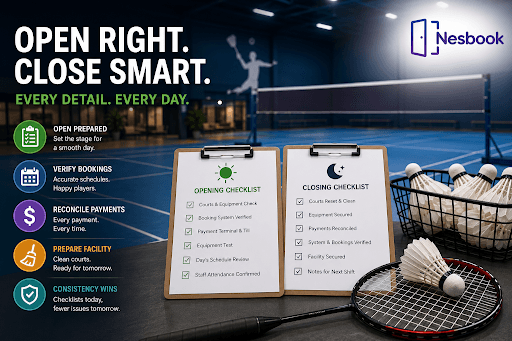
Opening & Closing Checklist for Badminton Facilities
Discover the essential opening and closing procedures every badminton facility should follow, including booking verification, payment reconciliation, facility preparation, and daily staff checklists.
Opening and closing are the two points in the day when the most can quietly go wrong: cash gets counted, systems get checked, and courts get handed from one shift to the next with nobody watching closely. Retail industry loss-prevention research consistently points to these two windows as the highest-risk periods in any business handling cash and inventory, precisely because they tend to happen with minimal staff and under time pressure. A badminton facility isn't a retail store, but the same structural risk applies to court resets, payment tills, and booking records. A written checklist, followed the same way every day, is the simplest fix available.
This builds on the broader daily operations routine for a badminton facility and the wider guide to managing a facility day to day — this piece focuses specifically on what belongs on the opening and closing lists themselves.
Opening Checklist
- Unlock and walk every court, checking nets, flooring, and lighting before the first booking arrives
- Confirm the booking system is live and reflects the previous night's closing state accurately
- Check the payment terminal and till float match what was recorded at close the night before
- Test equipment available for rental (rackets, shuttles) and remove anything damaged from circulation
- Review the day's booking sheet for anything unusual: large group bookings, coaching sessions, league matches needing extra setup
- Confirm staff scheduled for the day match who's actually present, and flag any gaps early
Closing Checklist
- Walk every court to confirm it's been reset and nothing was left behind by the last booking
- Secure or store rental equipment, flagging anything that needs repair or replacement
- Lock down access points and arm any security systems the facility uses
- Note anything unusual from the day — a maintenance issue, a member complaint, a booking dispute — for the next shift to see
- Confirm the following day's schedule doesn't have any conflicts that need resolving before the facility reopens
Booking Verification
Before closing out the day, it's worth double-checking that the booking system's record of the day matches what actually happened — not just what was originally scheduled. Cancellations, no-shows, and last-minute walk-ins all need to be reflected accurately, since a system that shows what was booked rather than what happened will quietly drift out of sync with reality over weeks.
This is also the point to confirm recurring bookings for the next day or week are still correctly held — a common failure point is a recurring slot that gets accidentally released or overwritten during a busy day, only discovered when the regular player or league shows up to find their court gone.
For facilities running multiple courts, it's worth spot-checking a few individual bookings against the master schedule rather than trusting the daily summary alone. A summary count can look correct — the right number of total bookings — while still containing a court mix-up that only shows up when someone actually cross-references the detail.
Payment Reconciliation
Cash, card, and any bank transfer payments taken during the day need to match what the booking and payment system shows before the till is closed out. Loss-prevention research across cash-handling businesses repeatedly finds that unreconciled discrepancies are far more often the result of process gaps — a payment logged to the wrong booking, a refund that wasn't recorded — than deliberate theft, but the fix is the same either way: a consistent reconciliation process followed every single night, not just when something feels off.
Any digital payment processing in use should also be PCI DSS compliant, regardless of facility size — worth confirming directly with whatever payment provider is in use rather than assuming it by default.
Reconciliation is also the point to catch billing issues before they compound — a membership charged twice, a deposit that was never applied to the final invoice. Catching these the same night they happen is considerably easier than untangling a month's worth of small errors during an end-of-quarter review.
Facility Preparation
Beyond bookings and payments, closing is also the point to prepare the facility itself for the next day: courts swept or cleaned as needed, lighting and climate control checked, and any facility-wide announcements or notices updated. Small maintenance issues — a loose net post, a flickering light — are far cheaper to flag and fix early than to let sit until a player notices and complains.
It's worth keeping a simple running log of maintenance items flagged during closing, even informally. A facility that only addresses maintenance reactively, once something actually fails mid-session, tends to spend more on emergency fixes and loses more goodwill with players than one that catches small issues during a routine closing walk-through.
FAQs
How long should opening and closing checklists actually take?
Long enough to cover the essentials without becoming a chore staff start skipping. Most badminton facilities can complete a properly scoped opening or closing checklist in 15–20 minutes; if it consistently takes much longer, the list is probably covering more than it needs to.
Should the same person handle opening and closing every day?
Not necessarily, but whoever's on duty should be following the same written checklist regardless of who they are. Rotating staff through opening and closing duties, using the same checklist, tends to catch more issues than always relying on one person's memory of how things are usually done.
What's the most commonly skipped step in badminton facility checklists?
Verifying recurring bookings are still correctly held for the next day. It's an easy step to assume is fine and skip, and it's also one of the more disruptive mistakes when it goes wrong, since it affects a regular player or league rather than a one-off booking.