
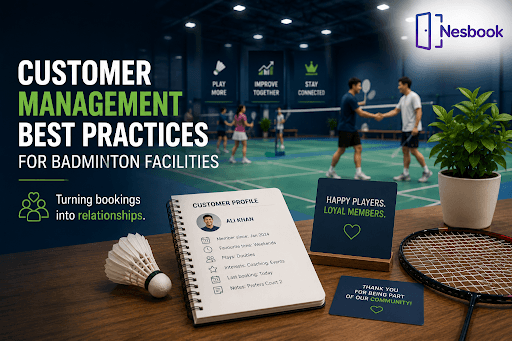
Customer Management Best Practices for Badminton Facilities: Turning Bookings Into Relationships
Learn how effective customer management helps badminton facilities improve player retention through customer profiles, booking history, personalized communication, and loyalty strategies.
A booking system tells you what court is reserved and when. It doesn't tell you who's a regular, who just had a bad experience last week, or who's close to lapsing on their membership without anyone noticing. That gap is where customer management sits — and it's a bigger factor in a badminton facility's long-term revenue than it usually gets credit for. This builds on the broader guide to managing a badminton facility and connects closely with how membership programs are run, since the two tend to reinforce each other.
Why Customer Profiles Matter More Than a Booking List
A booking list shows what happened. A customer profile shows who it happened to, and what that means going forward. Without one, every interaction starts from zero: staff don't know if the player at the desk is booking for the first time or the fiftieth, whether they've had an issue before, or whether they're a member due for renewal next week.
The table below outlines what's actually worth tracking in a useful customer profile — not to build an exhaustive database for its own sake, but because each field answers a question staff would otherwise have to ask, guess, or miss entirely.
| What to Track | Why It Actually Matters |
|---|---|
| Booking frequency and preferred time slots | Flags regulars worth recognizing and reveals when a usual visitor has quietly stopped visiting. |
| Membership or package status | Prevents staff from applying the wrong rate or missing a renewal conversation. |
| Past issues or complaints | Stops the same unresolved problem from being raised—and re-explained—repeatedly. |
| Communication preferences | Avoids over-messaging players who'd rather not receive promotional texts or emails. |
| Coaching or skill level (if applicable) | Helps match players to the right sessions or partners without re-asking every visit. |
Booking History: The Data Hiding in Plain Sight
Every facility already has this data sitting in its booking system — it's just rarely looked at as anything more than a record of what's been reserved. Reviewed properly, booking history answers questions that matter for retention specifically: which regulars haven't shown up in a few weeks, which time slots a given member consistently prefers, and which first-time visitors never came back a second time. This connects directly to how court usage and scheduling patterns show up across multiple courts, since the same underlying booking data drives both.
The value here isn't in the data itself, but in someone actually reviewing it on a regular cadence. A monthly glance at who's stopped booking, cross-referenced against who used to book weekly, tends to surface exactly the players worth a quick check-in call before they're gone for good.
Getting Communication Right, Without Overdoing It
Communication with players works best when it's specific and infrequent rather than generic and constant. A message about a membership renewal, a coaching slot opening up, or a facility closure affecting someone's usual booking time is useful. A weekly promotional blast to every player on file, regardless of relevance, tends to get tuned out — or actively resented. Twilio's State of Personalization Report found that 56% of consumers are more likely to become repeat customers after a personalized experience — a finding from broader consumer research, not badminton-specific, but the underlying logic holds here too: players notice when a facility remembers them specifically, versus treating every message as one-size-fits-all.
In practice, this usually just means using the customer profile data that's already being tracked — sending a renewal reminder to the person actually due for renewal, rather than a generic offer to the entire mailing list.
Building Genuine Loyalty Beyond a Punch Card
Loyalty programs and punch cards are a fine mechanical incentive, but the loyalty that actually keeps players coming back tends to come from smaller, less structured things: staff who recognize a regular by name, a facility that remembers someone's usual court preference, a quick and genuine response when something goes wrong. None of that requires software, though software makes it easier to sustain once a facility has more regulars than any one staff member can personally remember.
The economics behind this are well documented: Bain & Company's research on customer retention found that a 5% improvement in retention can lift profits by 25% to 95%, since repeat customers cost less to serve and tend to spend more over the length of the relationship than new ones. For a badminton facility, that translates directly into membership renewals, coaching package upgrades, and word-of-mouth referrals — all of which cost far less to earn from an existing player than from a new one.
Turning First-Time Visitors Into Repeat Customers
The first visit is where most of the groundwork for a repeat customer gets laid, often without anyone at the facility realizing it's happening. A first-time player who has a confusing booking experience, waits too long at the desk, or gets no follow-up after their visit is considerably less likely to come back than one who's greeted properly and, ideally, contacted afterward with something genuinely useful — a coaching option, a suitable regular session, or simply a thank-you.
A simple, low-effort habit worth building is flagging first-time bookings specifically, rather than treating them identically to a regular's tenth visit. That one distinction — noticing that someone is new — tends to be the difference between a visitor who never returns and one who becomes a long-term member.
FAQs
Is a formal loyalty program necessary for a badminton facility?
Not necessarily. A structured program can help, but the underlying behaviors that build loyalty — recognition, consistency, and responsiveness — matter more than the specific mechanics of any punch card or points system. A facility can build genuine repeat business without a formal program if staff and systems support those behaviors well.
How much customer data is actually worth tracking for a small facility?
Enough to answer the questions staff actually run into day to day — is this player a member, have they had a prior issue, when did they last book — rather than building an exhaustive profile for its own sake. More data isn't inherently useful if nobody reviews it.
What's the most common customer management mistake at badminton facilities?
Treating every player identically regardless of history. A regular who's booked weekly for two years and a first-time walk-in have very different needs and expectations, and a facility that doesn't distinguish between them tends to under-serve both.