
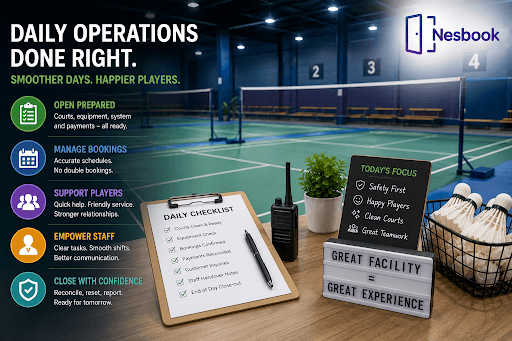
Daily Operations for a Modern Badminton Facility
Learn the daily operations that keep a badminton facility running smoothly, from opening procedures and booking management to staff coordination, customer service, and closing routines.
Most of what determines whether a badminton facility feels well-run or chaotic happens in the same handful of routines, repeated every day. Courts get opened and closed properly, bookings get managed without conflicts, players get looked after, and staff know exactly what's expected of them at each point in the day. None of this is complicated individually, but it's easy for small gaps to compound once a facility has multiple courts and shifting staff. This walks through the core daily routines in detail, building on the broader guide to managing a badminton facility and the fuller breakdown of facility management software if you're looking at the bigger operational picture.
Opening Procedures
A consistent opening routine catches small problems before they become the day's first complaint: lights and equipment working, courts properly reset from the night before, the booking system reflecting reality, and enough float in the till or payment terminal ready to go. Well-designed checklists have been shown, across fields from aviation to surgery, to catch errors that even experienced staff miss under time pressure — the same principle applies at a much lower stakes level to a facility opening for the day. A written, standardized opening and closing checklist removes the guesswork of relying on whichever staff member happens to be on shift that morning.
It is important when the regular opening staff member is away on a day off or in his first solo opening. A checklist in the mind of one person is gone when he or she is gone; one that is written down and adhered to is gone.
Booking Management
When the doors open, the majority of the day is spent on bookings: to confirm reservations, process walk-ins, deal with cancellations and maintain the schedule throughout the day. It's where small details add up quickly – someone books up on the phone before it's recorded in the system, a booking gets cancelled but it’s not updated with the next shift, a recurring league slot is accidentally double booked because it wasn't clearly marked as 'standing' in the system.
The aim on a hectic day is not simply to avoid double-up, it is also to avoid any other kind of failure. It ensures that no matter which employee is on duty at any hour, they can be sure that what they're reading about on the desk is accurate and not a result of a second-hand report or a request to another employee to verify.
Customer Support
Most day-to-day customer support at a badminton facility is immediate and in-person: a player asking about availability, a member with a billing question, someone needing help with equipment rental. The bar for what counts as good service has risen across nearly every industry — surveys on customer response expectations consistently find that people rate an immediate response as one of the most important things a business can get right, whatever the channel. For a facility, that mostly means not making a player wait at the desk while staff sort out a scheduling question that should have been resolved before they walked up.
The other half of customer support is less visible: following up on a booking issue after the fact, remembering a regular's usual preferences, or catching a member whose visits have quietly dropped off before they lapse entirely. This is harder to standardize into a checklist, but it's usually what separates a facility players are loyal to from one they merely use.
Staff Tasks
Each shift typically covers a mix of front-desk duties, coaching or session supervision, and light facility maintenance, and it helps for staff to know clearly which of these fall to them at any given hour rather than improvising. A closer look at staff scheduling for badminton facilities goes deeper into building shifts around actual demand patterns, but day-to-day, the simplest fix is a clear task list per shift: who's covering the desk, who's resetting courts between sessions, and who's responsible for handling an equipment issue if one comes up.
Communication between shifts matters just as much as tasks within a shift. A morning issue that isn't passed on to the afternoon team — a court with a loose net, a member who called in upset — tends to resurface later as a bigger problem than it needed to be.
Closing Procedures
Closing is where the day's loose ends get tied off: reconciling payments taken against what the system shows, resetting courts for the next morning, securing equipment, and flagging anything that needs attention before the facility reopens. The same opening and closing checklist that standardizes the morning routine should cover this end of the day too, since closing tends to get rushed by whoever's eager to leave and is exactly when steps get skipped.
A short end-of-day note — anything unusual that happened, anything still unresolved — costs a couple of minutes to write and consistently saves the next shift from re-discovering the same problem from scratch.
FAQs
How detailed should a daily operations checklist actually be?
Detailed enough to cover the steps that actually get missed, not every conceivable task. Checklists work best when they're short and focused on the handful of items that cause real problems if skipped, rather than an exhaustive list nobody reads all the way through.
What's the most common daily operations mistake at badminton facilities?
Inconsistent handoffs between shifts. A lot of operational friction doesn't come from any single mistake, but from information — a booking change, a maintenance issue, a member complaint — not making it from one shift to the next.
Does a small, single-court facility need this much daily structure?
A lighter version of it, yes. Even a single court benefits from a consistent open/close routine and clear booking records — the complexity just scales down, not away, since the same failure points (missed handoffs, unreconciled payments) can still happen at a smaller scale.