
What Is a Badminton Booking Platform?
Learn what a badminton booking platform is, how it works, and the key features that help clubs and sports facilities manage court bookings, payments, and schedules more efficiently.
A badminton booking platform is software that lets players see court availability, reserve time, and pay online while giving facility operators one place to manage schedules, payments, memberships, customer records, and court operations.
That sounds simple, but the difference between a basic calendar and a strong booking platform becomes obvious as a facility gets busier. A good system does more than put court times online. It keeps availability accurate, applies booking rules automatically, collects payments, reduces front-desk work, and gives operators a clearer view of how their courts are being used.
For players, the goal is straightforward: find a court, choose a time, pay, and know the reservation is confirmed. For operators, the goal is broader: keep courts full, reduce scheduling conflicts, manage customers, and spend less time on repetitive administration.
What Does a Badminton Booking Platform Do?
At its core, a badminton booking platform connects available court time with the people who want to book it.
Key features at a glance:
| Feature | Player benefit | Operator benefit |
|---|---|---|
| Real-time availability | See open courts immediately | Keep one live schedule |
| Online & mobile booking | Book from any device | Reduce front-desk scheduling |
| Integrated payments | Pay during checkout | Link reservations to revenue |
| Confirmations & reminders | Know the booking is set | Cut manual follow-up and no-shows |
| Recurring reservations | Keep regular time slots | Manage leagues, coaches, and regular groups |
| Memberships & packages | Get eligible pricing automatically | Apply discounts and privileges consistently |
| Customer records | Keep account and booking history together | Track bookings, payments, and customer activity |
| Waitlists & staff controls | Get access to newly open slots | Manage openings and staff permissions |
| Reporting & multi-location tools | Get a consistent experience across facilities | Analyze utilization across courts and locations |
The key advantage is that both sides use the same system. When a player books a court, the schedule updates for the customer and staff at the same time. That reduces the gaps that appear when phone calls, messages, spreadsheets, and paper calendars all contain different versions of the schedule.
Ready to move beyond spreadsheets and manual scheduling? Explore Nesbook to see how real-time booking, payments, memberships, and customer records can work together.
How Does Badminton Booking Software Work?
A typical booking starts with the facility defining its courts, operating hours, prices, and reservation rules.
For example, an operator may set:
- Court 1 through Court 8 as bookable resources
- Weekday and weekend hours
- 60-, 90-, or 120-minute booking blocks
- Peak and off-peak prices
- Member discounts
- Advance-booking limits
- Recurring booking permissions
Once those rules are in place, customers can see eligible time slots and make reservations without asking staff to manually check availability.
A basic customer journey looks like this:
Find the facility → View availability → Select a court and time → Confirm pricing → Pay → Receive confirmation
Behind the scenes, the platform should immediately update court availability, record the customer and payment details, apply the facility's rules, and make the reservation visible to staff.
That shared workflow is what turns a booking page into an operational system.
Why Manual Court Booking Becomes a Problem
Phone calls, text messages, WhatsApp groups, spreadsheets, and front-desk calendars can work when a club is small. The problem is that manual systems become harder to control as booking volume grows.
Common problems include:
- Double bookings. Two staff members may confirm the same court because they are working from different records.
- Missed bookings. Customers who want to reserve after business hours may not wait until someone answers the phone.
- Slow front-desk service. Staff have to check availability, collect details, take payment, and manually update the schedule.
- Inconsistent policies. Cancellation rules, discounts, and booking limits may depend on whoever is working at the time.
- Poor visibility. Owners may know the facility feels busy without knowing which courts, time periods, or customer groups generate the most revenue.
A booking platform reduces those problems by turning policies and availability into system rules instead of staff memory.
The Most Important Features in a Badminton Booking Platform
Not every feature has equal value. Facility owners should focus first on the parts of the system that affect booking accuracy, customer experience, and daily operations.
Real-Time Court Availability
Availability should update as soon as a booking, cancellation, maintenance block, or schedule change occurs.
If customers see outdated availability, the rest of the booking experience breaks down. Real-time scheduling helps prevent two people from being promised the same court and gives staff a reliable view of the day.
A Simple Mobile Booking Experience
Mobile usability is especially important because a booking platform is customer-facing software, not just an administrative tool.
A player should be able to open the booking page on a phone, find an available court, understand the price, and complete the reservation without working through unnecessary screens.
When evaluating platforms, count the steps required to complete a first-time booking. A long feature list matters less if customers struggle with the basic transaction.
Integrated Online Payments
Payments should connect directly to reservations.
Key payment functions:
| Payment function | Why it matters |
|---|---|
| Collect court fees at booking | Collect revenue during the reservation process |
| Apply deposits | Secure a reservation before play |
| Sell packages or credits | Bundle repeat visits or prepaid court time |
| Charge membership rates | Apply the correct price automatically |
| Issue receipts | Give customers immediate payment records |
| Track refunds | Handle reversals without losing reservation context |
| Reconcile booking revenue | Keep the schedule tied to actual revenue |
Integrated payments also give the operator a clearer connection between the court schedule and actual revenue.
Recurring Bookings
Regular badminton players often reserve the same time every week.
A useful platform should make recurring reservations easy to create and manage instead of forcing customers or staff to rebuild the same booking repeatedly.
Recurring booking support is especially useful for:
- Weekly player groups
- Coaches
- Leagues
- Training programs
- School groups
- Corporate bookings
Memberships and Packages
Many badminton facilities sell more than individual court time.
Membership plans, prepaid court packages, credits, coaching packages, and member discounts should connect to the booking process automatically.
The system should know what a customer is entitled to without requiring staff to calculate every discount or check a separate membership spreadsheet.
Automated Confirmations and Reminders
Customers should know immediately that a booking went through.
A clear confirmation should identify the facility, court, date, time, payment status, and any important arrival or cancellation information.
Automated reminders can then reinforce the reservation before the booking starts.
Customer Records
Booking history becomes more useful when it is connected to a customer profile.
Operators may want to see:
- Contact information
- Previous bookings
- Upcoming reservations
- Membership status
- Packages or credits
- Payment history
- Cancellations
- Notes or communication history
Keeping that information together makes it easier to serve repeat customers and understand customer behavior.
Reporting and Court Utilization
A booking platform should help owners answer questions that are difficult to answer from a paper calendar.
For example:
- Which courts are booked most often?
- What are the busiest hours?
- Which time periods are underused?
- How much revenue comes from court bookings?
- Which customers book most frequently?
- Are memberships increasing repeat use?
- How often are reservations cancelled?
- Where is additional capacity available?
That information can support decisions about staffing, pricing, memberships, promotions, and expansion.
Want clearer insight into how your courts are performing? Explore Nesbook to connect booking activity with customer, payment, and utilization data in one place.
What Is the Difference Between Booking Software and Facility Management Software?
A basic booking tool focuses on the reservation itself.
A facility-management platform connects reservations with other parts of the operation.
That can include:
- Payments
- Memberships
- Customer records
- Invoicing
- Staff access
- Reporting
- Communications
- Multiple courts
- Multiple locations
This distinction matters because a club may outgrow a simple online calendar.
If staff still have to maintain separate systems for customer records, payments, memberships, and reporting, putting reservations online may only solve one part of the workload.
A more connected platform can reduce duplicate data entry and give staff one operational view of the facility.
Who Uses a Badminton Booking Platform?
A booking platform usually serves three groups with different priorities:
- Players
- Members and Regular Groups
- Facility Operators and Staff
Players
Players want to see accurate availability and complete a reservation quickly. They care about clear pricing, mobile usability, confirmation, and confidence that the court will actually be available when they arrive.
Members and Regular Groups
Members, league players, coaches, and regular groups may need recurring reservations, booking privileges, packages, credits, discounted rates, or access to specific times.
Facility Operators and Staff
Operators need control over the schedule and the business rules behind it.
They may care about:
- Court utilization
- Revenue
- Customer records
- Membership activity
- Payment status
- Cancellations
- Staff workload
- Reporting
- Multi-location visibility
The strongest platforms serve all three groups without making the customer-facing experience unnecessarily complicated.
What Should Facility Owners Look for Before Choosing a Platform?
The best way to compare booking platforms is to test workflows rather than simply compare feature lists.
During a demo or free trial, ask the vendor to show you these 10 workflows:
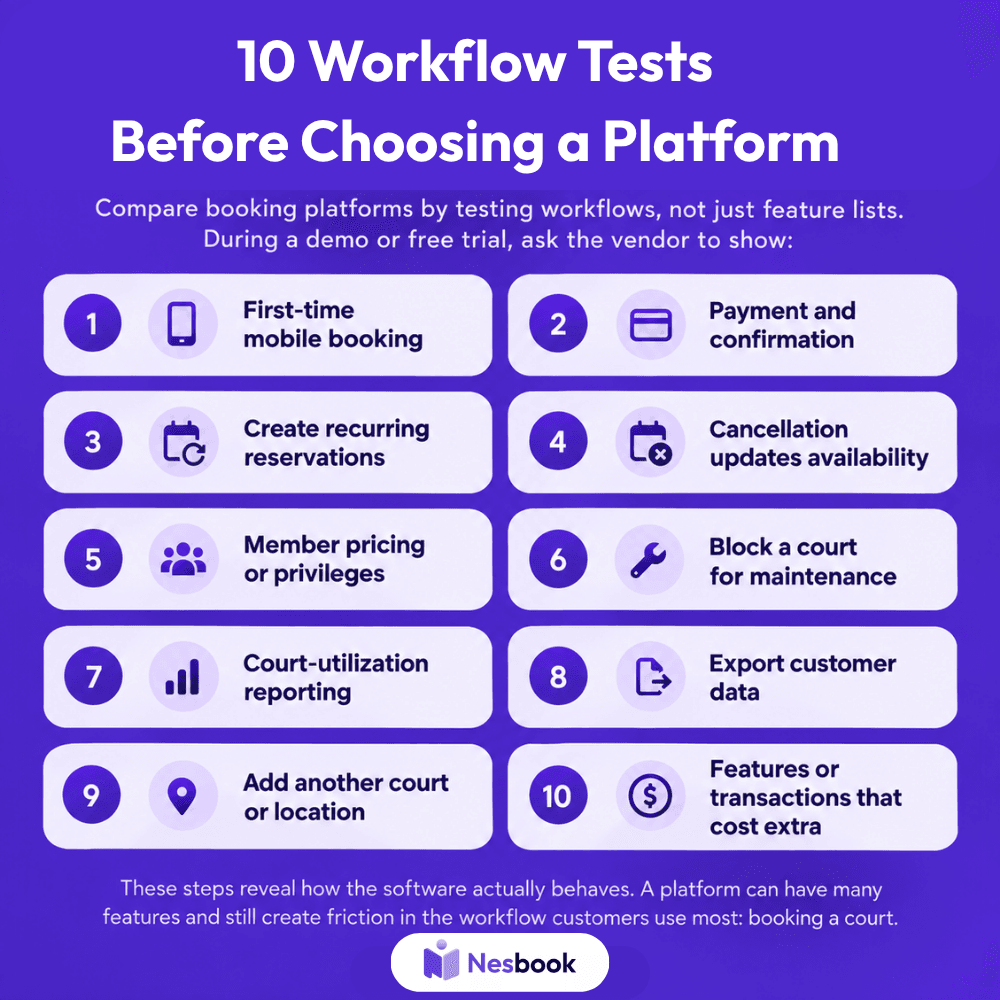
These steps reveal how the software actually behaves.
A platform can have dozens of features and still create friction in the one workflow customers use most often: booking a court.
How Much Does a Badminton Booking Platform Cost?
Pricing varies widely.
Some platforms charge a monthly subscription. Others price according to courts, locations, users, transaction volume, or feature modules. Payment processing, SMS messages, onboarding, premium support, and add-ons may also affect total cost.
Facility owners should compare the full operating cost rather than only the advertised starting price.
Cost areas to confirm
| Cost area | What to confirm |
|---|---|
| Subscription | Monthly vs. annual pricing and commitment discounts |
| Setup & onboarding | One-time implementation, training, or configuration fees |
| Payment processing | Transaction rates, markups, and gateway fees |
| SMS & notifications | Included message limits and per-message charges |
| Additional courts | Per-court fees and how pricing scales |
| Additional locations | Per-site fees and multi-location pricing |
| Staff users | Included seats and fees for extra logins |
| Reporting upgrades | Which reports require a higher tier |
| Support plans | What is included vs. paid priority support |
| Data migration | Import, cleanup, and setup charges |
| Contracts & cancellation | Term length, notice periods, and any exit fees |
The cheapest platform is not automatically the best value. Software that reduces administrative work and improves the customer booking experience can be worth more than a lower-priced system that requires constant workarounds.
Why the Customer Booking Experience Matters
Facility software is unusual because the operator is not the only person using it.
Your customers use it too.
That means ease of use can directly affect whether someone completes a reservation.
A booking flow should make four things obvious:
- What is available?
- What does it cost?
- How do I pay?
Is my booking confirmed?
Anything that makes those questions harder to answer adds friction.
This is especially important on mobile. A platform can be powerful for administrators while still feeling cumbersome to the player trying to reserve a court in less than a minute.
When two systems offer similar operational functionality, the simpler customer experience can become the meaningful difference.
Where Nesbook Fits
Nesbook is designed for badminton facility operators that want to connect court reservations with the wider operation of the venue.
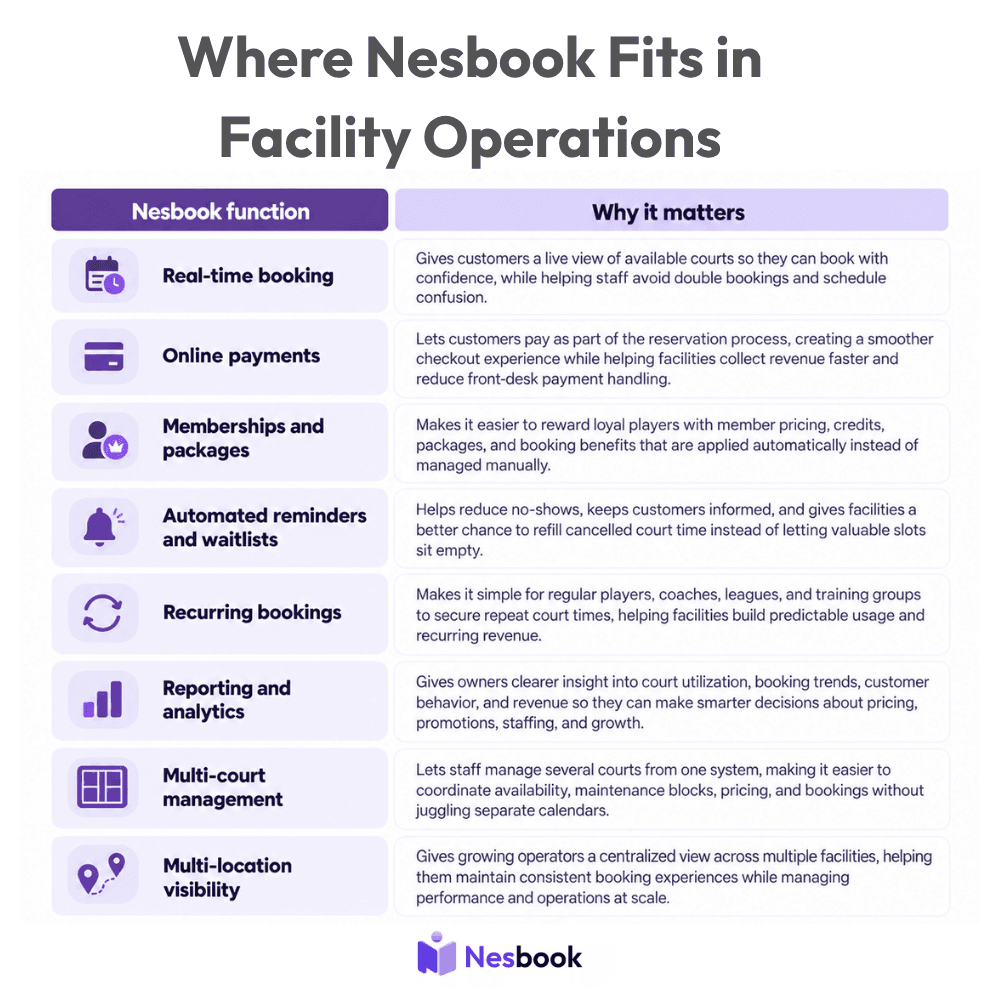
Want to simplify bookings without giving up control? Explore Nesbook to bring reservations, payments, memberships, reporting, and facility operations into one connected platform.
When Does a Facility Need a Booking Platform?
A facility should seriously consider booking software when manual scheduling starts creating operational friction.
Signs include:
- Staff regularly answer availability questions by phone or message
- Customers cannot book outside staffed hours
- Double bookings happen
- Payment collection is separated from the reservation process
- Membership privileges are tracked manually
- Regular groups require repeated data entry
- Staff maintain several overlapping spreadsheets
- Owners cannot easily measure court utilization
- Multiple courts or locations are becoming difficult to coordinate
The earlier these workflows are centralized, the easier it is to scale without adding unnecessary administrative work.
Frequently Asked Questions
Is a badminton booking platform the same as a booking app?
Not always. A booking app may refer only to the customer-facing reservation interface. A booking platform usually includes both the customer booking experience and the administrative tools used by the facility.
Can small badminton clubs use booking software?
Yes. Small clubs can benefit from online reservations, payments, confirmations, and recurring bookings even if they only operate a few courts. The key is choosing a system that is simple enough for the current operation and capable of supporting future growth.
Can a booking platform manage memberships?
Many platforms can. Membership functionality may include plans, discounts, packages, credits, booking privileges, renewal information, and payment tracking. Facilities should confirm exactly which membership functions are included.
Can badminton booking software prevent double bookings?
A system with real-time availability and centralized scheduling can greatly reduce double bookings by ensuring customers and staff work from the same live calendar.
Can customers book from their phones?
Most modern systems offer mobile access, but the quality of the experience varies. Facility owners should test the complete booking and payment process on a phone before choosing a platform.
Does booking software work for multiple locations?
Some platforms support multiple facilities or locations from one administrative account. This is important for operators that need centralized customer, payment, booking, and reporting data.
The Bottom Line
A badminton booking platform is more than an online calendar.
For players, it provides a faster way to see availability, reserve a court, pay, and receive confirmation.
For facility operators, it creates one system for managing court schedules, payments, memberships, customer information, recurring bookings, communication, and performance data.
The best platform should make operations easier without making booking harder for the customer.
That is the standard facility owners should use when comparing systems: enough control for the business, and as little friction as possible for the player.
Ready to Simplify Booking at Your Facility?
Explore Nesbook to see how online reservations, payments, memberships, recurring bookings, reminders, and reporting can work together in one system.