
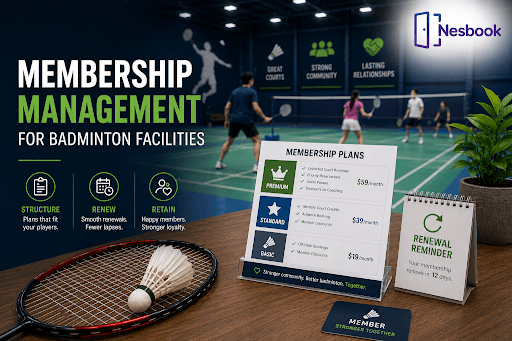
Membership Management for Badminton Facilities: Structuring Plans, Renewals, and Retention
Learn how to manage memberships at a badminton facility with practical guidance on membership plans, renewals, member benefits, communication, and automation to improve retention.
Memberships turn a badminton facility's revenue from a string of one-off bookings into something more predictable — but only if they're managed properly. A membership program that's poorly tracked creates its own problems: lapsed members who keep getting member pricing, renewal dates nobody's watching, and player frustration when benefits aren't applied consistently. This connects closely with customer management practices more broadly and sits within the wider facility management picture, since membership handling touches nearly every other operational area.
Choosing a Membership Structure That Actually Fits Your Players
There's no single correct membership structure — the right one depends on how players actually use the facility. A few common approaches:
| Structure | How It Works | Best Suited For |
|---|---|---|
| Monthly membership | Flat recurring fee for a set number of visits or unlimited access. | Regular players who book weekly or more often. |
| Punch card / session pack | A fixed number of prepaid sessions, used at any pace. | Occasional players who don't want a recurring charge. |
| Tiered membership | Multiple levels with different perks, such as off-peak access, full access, or coaching included. | Facilities with varied player needs and budgets. |
| Family or group plans | One membership covering multiple linked accounts. | Households or regular playing groups. |
Many facilities end up running more than one of these simultaneously, since a single structure rarely fits every type of player. The mistake worth avoiding is offering too many overlapping options, which makes it harder for both staff and players to keep track of who's entitled to what.
It's worth revisiting membership structures periodically rather than treating them as fixed once set. A facility that reviews actual usage patterns — which tier members are choosing, which one gets the most complaints about value — every year or so tends to catch pricing or structure mismatches before they quietly drive members toward a competitor.
Why Renewal Timing Deserves More Attention Than It Usually Gets
The period right after a membership starts is where most churn actually happens. Industry data from health and racquet club research shows that roughly half of new members at fitness and racquet facilities lapse within their first six months, and that members who go through a genuinely structured onboarding process are considerably more likely to stay active past that point. For a badminton facility, that means the first renewal — not the fifth — is usually the one worth paying closest attention to.
Reminders sent too late or not at all are one of the more avoidable causes of member churn. A member who forgets a renewal is far more likely to simply not come back than to proactively seek out a resubscription — the default outcome of an unprompted lapse is losing that member, not a phone call asking to rejoin.
A short onboarding check-in — a message a few weeks after a new membership starts, asking how things are going or flagging a session they might like — costs very little and directly targets the highest-risk window for cancellation, well before the first renewal date even arrives.
What Actually Counts as a Member Benefit
Discounted rates matter, but they're rarely the main reason a member stays. Priority booking access during busy hours, the ability to hold a standing weekly slot, and simple recognition from staff tend to matter more over time than the size of the discount itself. Benefits that require a member to remember to ask for them — rather than being applied automatically — tend to go unused and unappreciated, even when they're genuinely valuable.
Getting Member Communication Right
Consistent, low-friction communication is one of the more measurable levers a facility has over retention. The IHRSA Member Retention Report found that members who had two staff interactions in a given month made one additional visit the following month on average, and that each additional visit in a given month reduced the odds of cancellation the next month by roughly a third. That's a strong argument for proactive, if occasional, outreach — a check-in message, a renewal reminder, a note about a schedule change — rather than only communicating when a member is already at risk of leaving.
The volume matters as much as the content. Communication that feels relevant and occasional gets read; communication that feels constant and generic gets ignored, regardless of how useful any individual message might be.
Where Automation Removes the Manual Guesswork
Manually tracking renewal dates, usage credits, and applicable discounts becomes unmanageable well before a facility reaches a large membership base. Automated systems that flag upcoming renewals, apply the correct rate at checkout, and track remaining credits remove a recurring task that otherwise falls on staff every single day — and remove the risk of a lapsed member quietly continuing to receive member pricing because nobody caught the expiry. How online payments tie into this is worth reading directly, since renewal billing and payment processing are closely linked in practice.
Automation doesn't replace the human side of retention — a staff member who notices a member hasn't been in for a few weeks still matters. What it removes is the administrative burden that otherwise crowds out the time to do that noticing in the first place.
FAQs
How many membership tiers should a badminton facility actually offer?
Usually two to three is enough to cover meaningfully different player needs — for example, off-peak-only, full access, and a coaching-inclusive tier. More than that tends to create confusion for both staff and members without adding proportional value.
When should renewal reminders actually be sent?
Early enough that a member has time to act without feeling rushed — a first reminder a couple of weeks before expiry, with a follow-up closer to the date, tends to work better than a single last-minute notice that arrives after a member has already mentally moved on.
Is member communication worth the effort for a small facility with a lean staff?
Yes, and it doesn't need to be elaborate. Even a brief, personal check-in message to a member who hasn't booked in a few weeks tends to be more effective than an automated blast to the entire membership list, and it takes only a few minutes once flagged.