
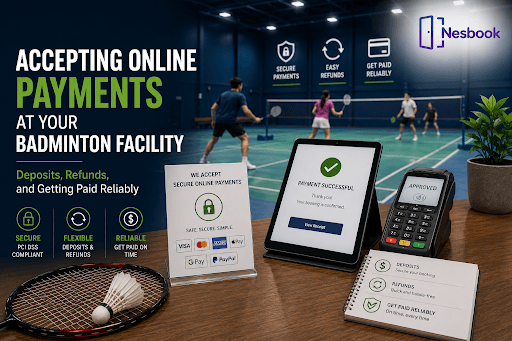
Accepting Online Payments at Your Badminton Facility: Deposits, Refunds, and Getting Paid Reliably
Learn how to accept online payments at your badminton facility with best practices for payment methods, deposits, refunds, automation, and revenue management.
Getting paid should be the simplest part of running a badminton facility, and yet it's often where the most avoidable friction shows up — chasing a payment after the fact, reconciling a mismatched till, or refunding a cancelled booking manually. Moving payments online, tied directly to bookings, removes most of this. This connects closely with how court scheduling itself is structured, since payment timing and booking timing are really the same problem, and sits within the broader facility management picture.
Payment Methods Worth Supporting
Not every player wants to pay the same way, and a facility that only supports one method tends to create friction for someone. Whatever combination a facility chooses, digital payment processing needs to be PCI DSS compliant, regardless of facility size — this isn't a nice-to-have, it's a baseline requirement worth confirming directly with any payment provider.
| Method | Advantage | Trade-off |
|---|---|---|
| Card / digital wallet at booking | Confirms commitment upfront and is the fastest to reconcile. | Requires PCI-compliant payment processing. |
| Cash at the desk | No processing fees and familiar to some players. | Slower reconciliation and a higher risk of manual errors. |
| Bank transfer | Useful for larger corporate or bulk bookings. | Slower to clear and harder to confirm instantly. |
| Stored card / card-on-file | Enables automatic no-show or late-cancellation charges. | Requires a clearly communicated policy to avoid disputes. |
Deposits: The Simplest Lever Against No-Shows
Collecting even a partial payment at the time of booking changes player behavior more than most facilities expect. OpenTable's own data across its restaurant booking platform found that deposits cut no-show rates by an average of 57% and made guests 72% less likely to cancel at the last minute. That data comes from restaurant reservations rather than badminton courts specifically, but the underlying mechanism — a real financial stake making a booking feel committed rather than tentative — applies just as directly to court time.
The size of the deposit matters less than the fact that one exists. A modest, clearly communicated deposit tends to filter out casual, low-commitment bookings without meaningfully discouraging genuine ones — the goal isn't to extract more money, it's to make sure the people booking a court actually intend to use it.
Handling Refunds Without Turning Into a Dispute
A clear, published refund and cancellation policy prevents most disputes before they start. Players are generally reasonable about cancellation windows and partial refunds when the policy is stated upfront and applied consistently — the friction tends to come from ambiguity, not from the policy itself being strict.
Automating refunds against the original payment method, rather than handling them as a manual adjustment days later, also matters more than it might seem. A refund that takes a week to process, or requires a player to follow up to confirm it happened, erodes trust in a way that's disproportionate to the actual amount involved.
It also helps to apply the policy the same way regardless of who's at the front desk. A refund granted informally by one staff member and denied by another for a similar situation creates exactly the kind of inconsistency that turns a routine cancellation into a genuine complaint — the policy itself matters less than whether it's applied predictably every time.
Payment Automation: Where Manual Reconciliation Breaks Down
Manually matching payments to bookings works fine at low volume and becomes unmanageable quickly as a facility grows. This is closely tied to how membership renewals and billing are handled, since a facility running both one-off bookings and recurring membership charges needs both to reconcile against the same underlying system, not two separate processes that have to be manually cross-checked against each other.
Automation doesn't just save staff time, though that's real. It also closes the gap where errors actually happen — a payment logged against the wrong booking, a refund that's approved verbally but never processed, a membership charged at the wrong rate because a discount wasn't applied automatically. These are rarely dramatic failures individually, but they compound steadily over months if reconciliation depends on someone remembering to check.
The other benefit is speed at month-end. A facility with automated reconciliation can close out a month's accounting in the time it takes to export a report; one relying on manual matching across cash, card, and bank transfer records tends to spend days rebuilding a picture the system should have already had.
Revenue Collection: Seeing the Full Picture, Not Just the Till
Payment data is worth more than just knowing how much came in on a given day. Broken down by court, time slot, membership type, and coaching versus casual play, it starts answering real questions: which time slots are worth repricing, which membership tier is actually driving revenue, and whether deposits are meaningfully reducing no-shows or just adding friction at booking.
This is only possible if payment data is captured consistently and tied to the booking it belongs to from the start. A facility reconciling cash, card, and bank transfers through three separate processes tends to have revenue data that's technically accurate in total but nearly useless for making any specific pricing or staffing decision.
FAQs
Is it reasonable to require a deposit for casual, one-off court bookings?
Generally yes, particularly for peak-hour slots where a no-show has a real cost in lost revenue. A modest, clearly stated deposit tends to filter out low-commitment bookings without discouraging genuine ones.
What's the biggest mistake facilities make with online payments?
Treating refunds as a manual afterthought rather than an automated part of the booking flow. A slow or inconsistent refund process does disproportionate damage to player trust relative to the amounts usually involved.
Do small facilities really need PCI-compliant payment processing?
Yes, regardless of size or transaction volume. PCI compliance isn't scaled to business size — any facility processing card payments online needs it, and it's worth confirming directly with a payment provider rather than assuming it's automatically covered.