
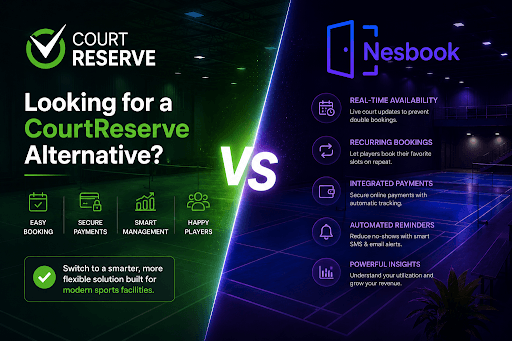
CourtReserve Alternative: Why Badminton Clubs Are Switching
Looking for a CourtReserve alternative? Compare CourtReserve and Nesbook to see which platform better fits badminton clubs based on features, pricing, mobile experience, and migration.
CourtReserve has been around since 2016 and works well for a lot of tennis and pickleball clubs — that's explicitly who it's built for. (CourtReserve) Badminton facilities keep running into the same issue: the platform's own marketing, feature pages, and curated software lists talk about tennis and pickleball throughout and don't mention badminton. (CourtReserve) That's reflected in the small but real friction a badminton club runs into trying to make it work.
You're already feeling that mismatch if you're looking for something more suited to how badminton actually runs. This article covers why badminton clubs move away from CourtReserve, what to compare before making the switch, and how the migration itself typically goes.
Why Clubs Look for CourtReserve Alternatives
Most clubs don't change software without a reason. It usually starts with a specific frustration that keeps recurring — a booking rule that doesn't match how the courts get used, a mobile app that gets clumsy on a busy Saturday afternoon, or a pricing structure that keeps climbing once add-ons get factored in.
The platform's booking logic was built around tennis and pickleball court scheduling, and badminton clubs tend to notice the gap: shorter booking durations, faster turnovers, and different doubles/court-sharing patterns than the sports CourtReserve was designed around.
If you're already comparing alternatives, it helps to zoom out first with this overview of what to look for before you start comparing platforms and a rundown of the top-rated platforms this year before committing to a switch.
Common Pain Points
- Mobile booking friction. Independent user reviews cite the mobile app not saving login details reliably, and note that booking more than one slot at a time takes extra steps. (Software Advice, GetApp)
- Rigid reservation rules. Reviewers report that certain booking restrictions and limited full-schedule views feel geared toward how tennis courts get used, which doesn't always translate to badminton's faster booking cycles. (GetApp)
- Add-on costs that stack up. CourtReserve's Pay-as-you-grow plan adds roughly $5/month per court and $5/month per instructor on top of the base tier, with additional features sold as separate add-ons — a structure that can push the real monthly cost well past what a small facility first expects. (Capterra)
None of this makes CourtReserve a bad platform. It's built for a different primary audience, and badminton clubs feel that mismatch the longer they use it.
CourtReserve vs Nesbook
CourtReserve is a club management platform covering tennis, pickleball, and other racquet sports, with member communication tools, event scheduling, and reporting aimed at multi-sport clubs. Nesbook takes a narrower starting point: it's a booking platform built with badminton court operations specifically in mind — court time blocks, memberships, and mobile-first booking. (Nesbook)
That difference shows up most in the details. A badminton club using CourtReserve is often configuring settings that were designed with tennis courts in mind. A badminton club on a badminton-specific platform generally starts from defaults that already assume badminton's booking rhythm, rather than adapting settings built for another sport.
Pricing Comparison
CourtReserve publishes its pricing: a base monthly fee, plus roughly $5/month per court and $5/month per instructor on the Pay-as-you-grow plan, with additional features priced as separate add-ons. (Capterra) For a small badminton facility, those per-court and per-add-on charges can add up quickly relative to the core features actually being used.
Nesbook publishes transparent pricing rather than relying on custom quotes. Plans start at $19.99/month, which includes one bookable space, with each additional space costing $1.99/month. Core features—including online booking, scheduling, payments, invoicing, unlimited customers, and customer notifications—are included in the base plan with no setup fees or long-term contracts. By contrast, CourtReserve's pricing typically scales based on factors such as the number of courts, active members, and feature tier, making the two platforms different in how they structure costs rather than just the monthly price.
Feature Comparison
Both platforms cover the basics: online booking, payment processing, and member management. Where they differ is in what each one was built around:
- Court configuration — CourtReserve's booking engine and feature set are built around tennis and pickleball court types and combo-court setups. Configuring your courts in Nesbook requires navigating to the venue management dashboard to map out your physical spaces, set availability, and define pricing. Nesbook is designed to handle multiple courts simultaneously, with real-time availability across all of them visible from a single dashboard.
- Mobile experience — CourtReserve users have flagged friction with saved logins and multi-slot bookings on mobile in independent reviews; badminton-specific platforms are generally built mobile-first around single-court, quick-turnaround bookings. Nesbook is designed with a mobile-first booking experience that prioritizes speed and simplicity, reducing friction through a streamlined interface optimized for quick, single-session bookings. This makes it especially well suited for badminton clubs and other sports venues where customers expect to find availability and complete a booking in just a few taps.
- Pricing structure — Nesbook offers transparent, flat-rate pricing starting at $19.99/month, which includes one bookable space. Each additional bookable space costs just $1.99/month, with no setup fees, unlimited customers, and core features such as online booking, scheduling, payments, invoicing, custom booking rules, and email reminders included in the base plan. Businesses can scale by adding more spaces at any time without changing plans or long-term contracts. In comparison, CourtReserve's pricing typically starts at around $25/month and scales based on the number of courts, active members, and the feature tier selected..
Neither platform is objectively "better" across every category — it depends on whether your facility runs multiple racquet sports or focuses specifically on badminton.
For a broader feature-by-feature view beyond CourtReserve, this side-by-side look at pricing and value across several platforms digs into more options, and if Mindbody is also on your shortlist, a direct comparison for Mindbody users considering a switch covers that one directly.
Migration Process
Switching booking software sounds more disruptive than it usually is. The general steps look like this:
- 1. Export your data. Member lists, booking history, and payment records typically export from CourtReserve in standard formats like CSV.
- 2. Set up your new court structure. Configure courts, hours, and pricing rules in the new platform before bringing members over.
- 3. Import member data. Most platforms support bulk member imports rather than manual re-entry.
- 4. Run a short overlap period. Keeping both systems active for a week or two while members adjust reduces confusion.
- 5. Communicate the change early. A heads-up email or app notification a week before the switch prevents a flood of "how do I book now" messages on day one.
Most clubs complete the switch within a couple of weeks, with the bulk of the work happening in data export and court setup rather than the actual cutover.
Which Software Is Better?
There isn't a universal answer — it depends on what your facility actually runs. A multi-sport country club managing tennis, pickleball, and social events alongside badminton may find CourtReserve's broader feature set worth the added cost and complexity. A facility focused specifically on badminton, whether a dedicated badminton center or a club running multiple badminton courts, will likely find a badminton-specific platform fits with less setup work and fewer workarounds.
The clearest signal is how much time your staff currently spends adjusting settings that weren't designed for badminton in the first place. If that list keeps growing, it's usually a sign the platform underneath isn't the right long-term fit.
FAQs
Is CourtReserve bad for badminton clubs?
Not bad, but not purpose-built either. It works, but badminton clubs often end up configuring features designed for tennis and pickleball.
How long does switching from CourtReserve typically take?
Most clubs complete a full migration within one to two weeks, including a short overlap period where both systems stay active.
Will we lose our booking history if we switch?
Most platforms support exporting booking and member history from CourtReserve, so it can be imported rather than lost.
Does switching software disrupt members during the transition?
A short overlap period and early communication usually prevent major disruption. Most members adjust within their first one or two bookings on the new system.