
Badminton Booking Software Comparison: Features, Pricing & Value
Not all badminton booking software delivers the same value. This comparison examines pricing, features, free trials, and ideal use cases across seven popular platforms to help you choose the right solution for your facility.
Choosing badminton booking software can get confusing fast.
Most platforms advertise similar benefits: online booking, mobile access, payments, scheduling, and customer management. The real differences show up when you look at how those features work together, what they cost, and whether the software fits the way your facility actually operates.
A small badminton club with three courts has very different needs from a large sports center with multiple locations, memberships, coaches, and tournaments.
This guide compares the major factors that matter when evaluating badminton booking software so you can focus on value rather than simply choosing the platform with the longest feature list.
What Should You Compare In Badminton Booking Software?
Start with the functions your facility actually needs.
For most badminton operators, that means comparing:
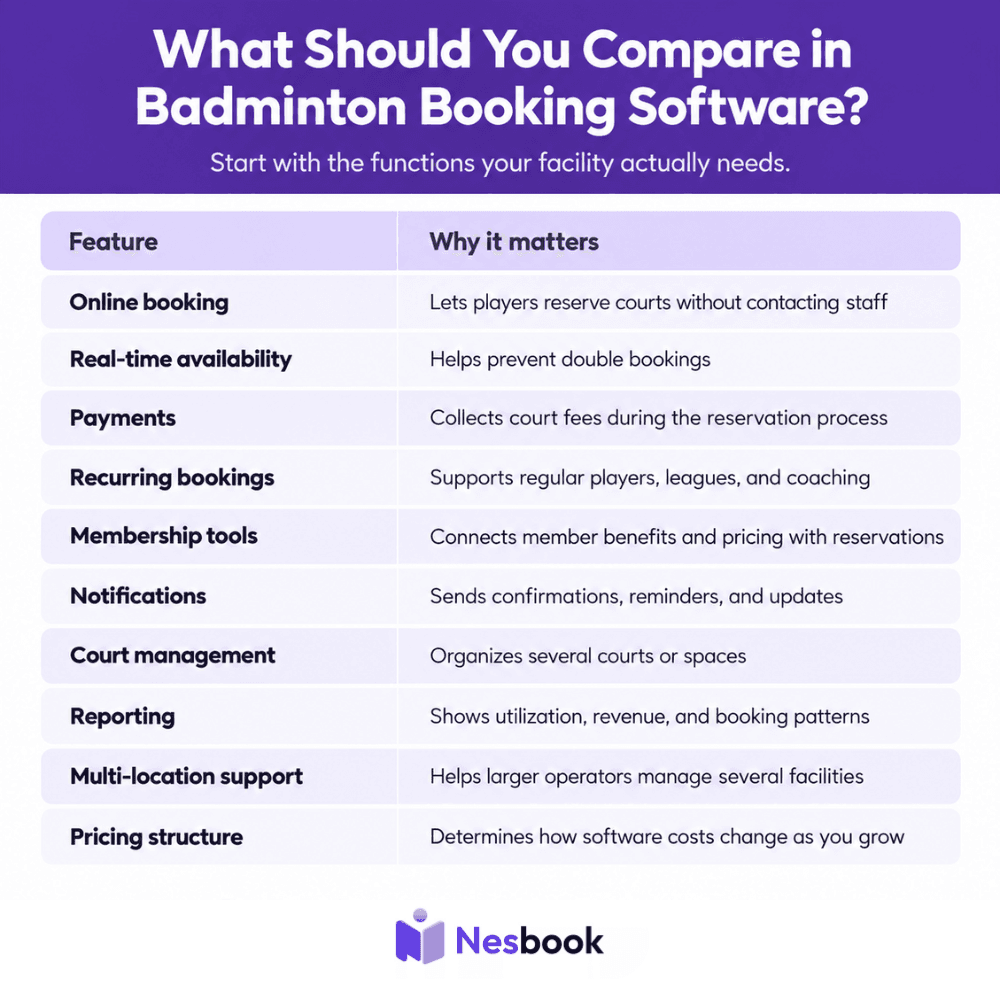
The best platform isn’t necessarily the one that checks every box. Instead, it is the one that handles the functions you actually use without forcing your staff to create workarounds.
Ready to see how Nesbook fits your facility? Explore Nesbook to compare its booking, scheduling, payments, and facility management tools with what your club uses today.
Badminton Booking Software Comparison
The badminton and court-booking market includes several types of platforms.
Some are designed specifically around racquet sports. Others are broader scheduling platforms that can be configured for courts. Some focus more heavily on coaching, tournaments, memberships, or multi-location management.
Here is a quick comparison:
| Platform | Best suited for | Pricing approach | Primary strength |
|---|---|---|---|
| Nesbook | Facilities that want powerful management tools with a simpler customer booking experience | Published starting price | Streamlined booking experience with strong facility-management tools |
| CourtReserve | Racquet clubs with memberships and programs | Tiered/scaled pricing | Racquet-sport club management |
| Bookteq | Multi-site and community sports facilities | Quote-based | Venue and multi-site management |
| Omnify | Clubs with classes and coaching programs | Plan-based | Classes, memberships, and scheduling |
| ManageSports | Smaller sports clubs | Varies by facility | Straightforward sports booking |
| Anolla | Academies and training-focused facilities | Modular/usage-based | Training and tournament features |
| AllBooked | Mixed-use facilities | Quote-based | Flexible space management |
Note: Pricing and features can change, so facilities should always confirm current terms directly with vendors before making a purchasing decision.
Nesbook
Best for: Facilities that want powerful operations with a simple customer booking experience
Nesbook combines online booking with tools for managing the wider facility.
Core functions include:
- Online reservations
- Scheduling
- Payments and invoicing
- Customer records
- Notifications
- Multiple bookable spaces
- Reporting
One important difference is how much of the facility workflow Nesbook brings into one system.
Rather than treating booking as a standalone calendar, Nesbook connects reservations with scheduling, payments, invoicing, customer records, notifications, and reporting. This can be especially useful for growing badminton facilities that want staff to manage day-to-day operations without switching between multiple disconnected tools.
Where Nesbook offers value
Nesbook makes the most sense when a facility wants strong operational tools without making the customer booking experience unnecessarily complicated. Its value comes from keeping both sides of the workflow straightforward: facility operators can manage day-to-day operations while customers get a faster, more intuitive way to reserve courts.
That can make it a strong fit for:
- Independent badminton centers
- Growing clubs
- Multi-court facilities
- Facilities adding memberships or coaching
- Owners who want clearer software costs as they grow
CourtReserve
Best for: Established racquet clubs with memberships and programming
CourtReserve is a well-established racquet-sports platform with strong support for badminton facilities as well as other court-based sports.
That gives it strong functionality for clubs managing:
- Court reservations
- Memberships
- Events
- Programs
- Leagues
- Payments
It is particularly well suited to organizations operating across several racquet sports and managing extensive memberships, programs, and events.
For badminton facilities, the more useful comparison is not whether CourtReserve supports the sport, but how easily operators and customers can move through everyday booking workflows.
CourtReserve offers extensive functionality for venue administrators, but some customer-facing workflows can feel more complex than necessary, particularly when players are trying to make a quick booking on mobile.
Nesbook takes a more streamlined approach, aiming to give operators the tools they need while keeping court reservations fast and intuitive for customers.
Bookteq
Best for: Multi-site and community sports facilities
Bookteq is more relevant when the facility isn’t limited to badminton.
For example, an operator might manage:
- Badminton courts
- Football pitches
- Gyms
- Community halls
- School facilities
- Several venues
Its broader venue-management orientation can be useful when management needs visibility across multiple spaces or locations.
For a small badminton-only operator, some of that functionality may be more than necessary.
Omnify
Best for: Facilities built around coaching and structured programs
Omnify combines bookings with services, classes, memberships, and payments.
That can make it useful for badminton academies where the business model involves more than hourly court rental.
Consider it when your facility manages:
- Private lessons
- Group coaching
- Junior programs
- Camps
- Classes
- Memberships
- Multiple instructors
For a facility focused mostly on simple court reservations, a more court-centered product may provide a simpler workflow.
ManageSports
Best for: Smaller clubs looking for straightforward sports scheduling
ManageSports focuses on sports organizations and facility management.
Its functionality can suit clubs that primarily need:
- Online reservations
- Scheduling
- Payments
- Basic customer management
A smaller organization may prefer this type of system if it does not require advanced multi-location or enterprise functionality.
Anolla
Best for: Badminton academies and training programs
Anolla takes a more modular approach.
Facilities can add functionality around areas such as:
- Training groups
- Tournament registration
- Billing
- Scheduling
That can be useful for operators whose business revolves around instruction or organized competition.
The modular model also means facilities should look carefully at which features are included and which features increase the total cost.
Nesbook’s current software comparison describes Anolla as particularly useful for academies with substantial coaching or tournament operations.
AllBooked
Best for: Facilities managing several different types of spaces
AllBooked is broader than badminton.
It can work well for organizations that need to schedule several different types of resources.
For example:
Community Sports Center
- 4 badminton courts
- 2 meeting rooms
- 1 basketball court
- 1 event hall
A general space-booking platform may make more sense there than software designed around only one sport.
For a dedicated badminton center, however, broader space-management functionality may provide less value than features specifically tied to court operations.
How Much Should Badminton Booking Software Cost?
There isn’t one correct price.
The more useful question is:
What does the software cost relative to the work and revenue it affects?
A platform costing $40 per month could be expensive if nobody uses it.
A platform costing several hundred dollars per month could be inexpensive if it replaces hours of administrative work and helps manage hundreds of bookings.
Look beyond the monthly subscription
Ask about:
- Setup fees
- Payment-processing fees
- SMS charges
- Additional court fees
- Staff-user fees
- Premium reporting
- Support packages
- Contracts
- Cancellation fees
- Data migration
- Add-on modules
Need more info? Nesbook’s affordability guide specifically warns that payment markups, SMS charges, onboarding, support tiers, and other extras can make a low advertised price considerably more expensive in practice.
Cheap Software Vs. Good Value
These aren’t the same thing.
Consider two hypothetical systems.
| Software A | Software B | |
|---|---|---|
| Monthly price | $30 | $80 |
| Online booking | Yes | Yes |
| Payments | Extra | Included |
| Text reminders | Extra | Included |
| Reporting | Limited | Included |
| Recurring bookings | No | Yes |
| Membership tools | No | Yes |
Software A is cheaper.
But if the club needs the missing functions, the lower price may not represent better value.
A useful formula is:
Software value = useful functionality + labor saved + revenue supported − total cost
You don’t need to calculate that down to the penny.
The point is to compare software according to what it actually does for the business.
Which Features Are Worth Paying For?
Some capabilities should be treated as core features rather than extras.
Real-time availability
If availability isn’t accurate, the entire booking experience breaks down.
Online payments
Collecting payment during booking reduces work for staff and creates a clearer connection between reservations and revenue.
Recurring bookings
Regular players, leagues, and coaches should not have to manually reserve the same court every week.
Automated reminders
Reminders can reduce forgotten reservations and make cancellations easier to manage.
Reporting
At minimum, facility owners should be able to see when courts are being used.
Without reporting, owners may know that they’re “busy” without knowing which hours or courts actually generate the most value.
How Facility Size Should Affect Your Choice
Small clubs
Prioritize:
- Low starting cost
- Easy setup
- Online booking
- Payments
- Recurring reservations
- Mobile usability
A two-court club probably doesn’t need an enterprise platform.
Read Nesbook’s guide for small clubs to learn about prioritizing simple setup, self-service reservations, recurring bookings, mobile functionality, and pricing that scales with court count.
Growing badminton facilities
Prioritize:
- Membership integration
- Reporting
- Customer profiles
- Coaching
- Automated communication
- Flexible pricing
- Multiple courts
At this stage, disconnected tools begin creating more administrative work.
Large or multi-location facilities
Prioritize:
- Central reporting
- Staff permissions
- Multi-location management
- Advanced scheduling
- Data migration
- Integrations
- Reliable support
The cheapest system matters less if staff need to maintain several separate databases.
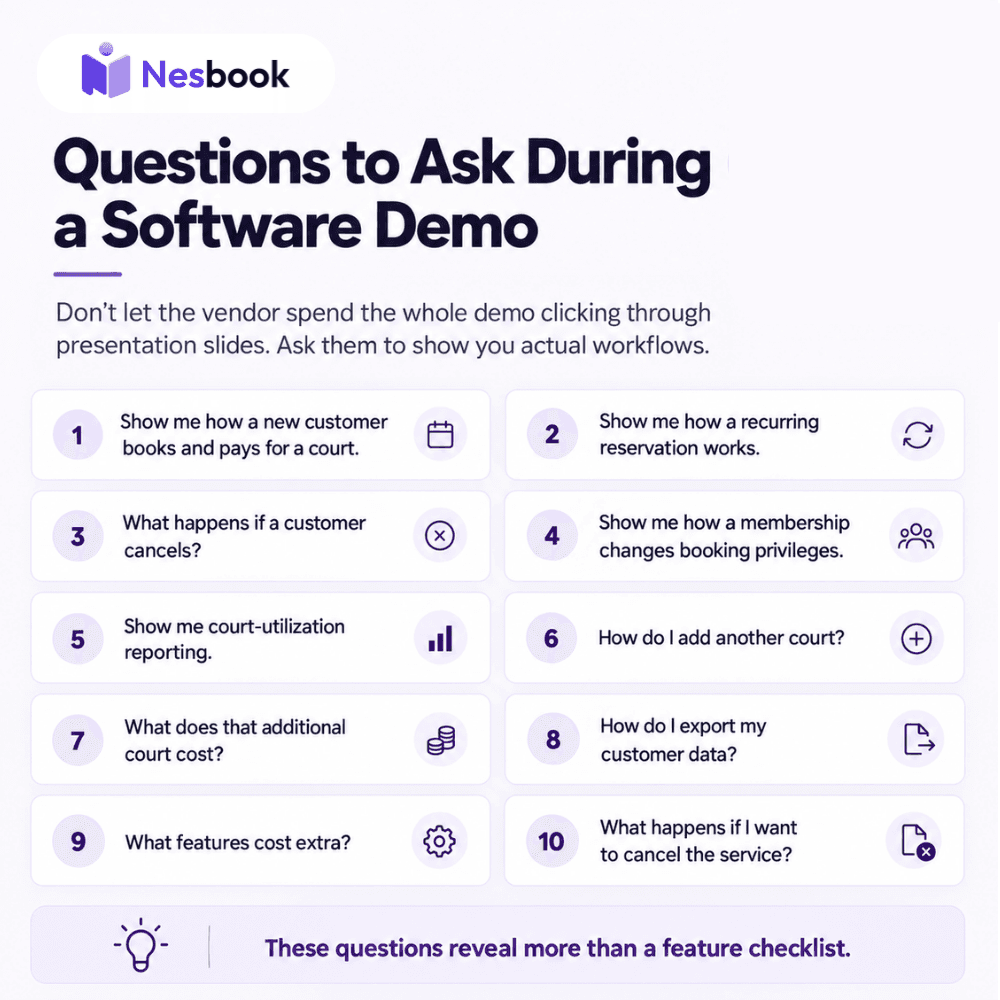
Questions To Ask During A Software Demo
Which Badminton Booking Software Offers The Best Value?
There isn’t one platform that is automatically best for every facility.
- CourtReserve may make sense for a larger racquet club running extensive memberships and programming.
- Bookteq may fit an organization managing several venues.
- Omnify may work well for an academy centered around classes and coaching.
- Anolla may appeal to training-focused facilities that want modular functionality.
- And Nesbook is worth considering when you want strong facility-management tools paired with a streamlined customer booking experience across court reservations, scheduling, payments, and customer management.
The right decision comes down to three questions:
- Does it solve the problems you have today?
- Can it support the facility you expect to have tomorrow?
- And does the total cost make sense for the value you’re getting?
Ready to compare your options?
Ready to Compare Your Options?
Before choosing badminton booking software, list the functions your facility actually needs and test those workflows with each platform. Nesbook brings bookings, scheduling, payments, customers, and facility management together in one system.