
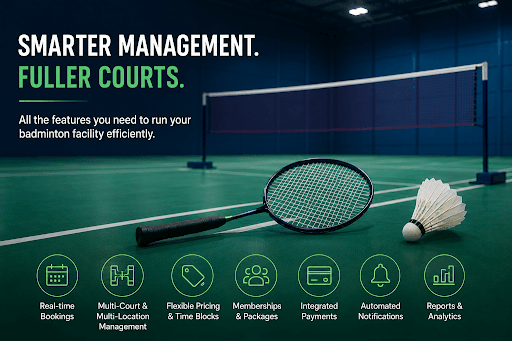
Badminton Court Management Software: Features Every Facility Needs
Learn the essential features every badminton court management software should offer, from real-time court scheduling and online payments to memberships, reporting, and multi-court management.
A badminton court is, at its core, a perishable resource — much like a hotel room or an airline seat. An empty hour on Court 3 at 7pm can't be sold again once it's gone. That's the problem badminton court management software exists to solve: keeping courts booked, cutting down on admin, and giving facility owners the visibility they need to actually run the place profitably rather than just watch it happen.
The trouble is that plenty of platforms call themselves "court management software" without doing much more than replacing a paper calendar. This is a breakdown of the features that separate the two — and what to actually check for before signing a contract.
If you haven't yet worked through the fundamentals of picking booking software for your facility, that's a useful starting point before diving into feature specifics here.
Real-Time Court Availability & Booking
The most important thing any court management system needs to get right is accuracy. Players need to see which courts are open, at what times, without calling ahead to guess or risk a conflict. For the facility, that means every booking — whether it comes in online, through an app, or at the front desk — has to update the same underlying schedule instantly.
Without that, facilities fall back on guesswork: checking a paper sheet, hoping nobody double-booked the same slot, or waiting on a phone call to confirm. Real-time syncing removes that uncertainty entirely, and it's the foundation everything else in this list depends on.
Multi-Court and Multi-Location Management
Very few badminton facilities run a single court. Most operate several at once, and plenty of operators eventually add a second or third location. Handling this well — one system, one login, every court and site visible together — shouldn't be an afterthought bolted onto software built for something else. What a multi-location, enterprise setup needs on top of the basics covers this in more depth if you're managing several sites already.
Flexible Pricing and Time Block Configuration
Badminton facilities rarely run on one flat price. Peak evening hours might cost more, early mornings might be discounted, and coaching sessions might run on a completely different time-block format than casual court rentals. Good court management software supports this natively.
Look for systems that let you set custom time-block lengths — 30 minutes, 60 minutes, or anything in between — assign different pricing to different windows, and change those rules yourself without waiting on a developer or a support ticket.
Membership and Package Tracking
Court rentals are rarely a facility's only revenue stream. Many badminton clubs run monthly memberships, punch cards, and bundled coaching packages alongside regular bookings — and tracking all of that by hand becomes a real administrative burden as a facility grows.
Good software handles this automatically: remaining credits are tracked, renewal dates are flagged, member discounts apply at checkout, and bookings are restricted once a balance runs out. This isn't just a convenience — without clean tracking, it's genuinely difficult to tell which membership tiers are actually profitable and which ones are just administrative overhead.
Integrated Payment Processing
Collecting cash, card, and bank transfer payments by hand is slow and invites errors. Court management software with integrated payment processing attaches transaction details to each booking automatically, removing the need for manual end-of-day reconciliation.
It also cuts down on no-shows. When a player pays at the time of booking rather than on arrival, there's a financial commitment attached that makes a last-minute cancellation less likely.
Automated Notifications and Reminders
Most no-shows and late cancellations come down to forgetfulness, not bad intent. Automated email or SMS reminders solve this directly, without staff needing to chase every player individually.
The same logic should extend to cancellations and waitlists. When a booking is cancelled, the next person on the waitlist should be notified automatically — turning something that's normally a manual, reactive scramble into a process that runs itself.
Recurring Bookings and League Support
Leagues, standing coaching sessions, and regular players holding the same weekly slot are the norm at most badminton facilities, and they shouldn't need to be re-entered by hand every week. A proper system should support recurring bookings that hold a time slot permanently — or until changed — so a slot doesn't accidentally get double-booked months down the line. If leagues are a bigger part of your operation, the club-management side of this — memberships, coaches, and communication tools is worth a look as well.
Bracket management or full team-scheduling tools can help facilities running organized leagues, but they're a step beyond basic booking and won't be necessary for every venue.
Reporting and Analytics
is actually running. Useful reports include court utilization by time of day, revenue broken down by membership type or service, peak versus quiet periods, and retention trends over time.
That data answers real operational questions: which courts are underperforming and could be repriced, when extra staff are actually worth scheduling, and which membership tiers are genuinely generating revenue versus just adding overhead. If getting that data out means manually exporting and cross-referencing spreadsheets, it tends to be a task that quietly never gets done.
Mobile-First Booking Experience
Most players expect to book from their phone, not a desktop browser. Court management software needs a proper app or a genuinely mobile-friendly interface — not a desktop site that's merely viewable on a smaller screen. A clunky mobile booking flow costs facilities real bookings, since players who get frustrated tend to just close the tab rather than push through.
What This Looks Like Put Together
These features work best as one connected system rather than a handful of separate tools stitched together — scheduling, pricing, payments, memberships, and reporting all pulling from the same real-time data. Nesbook was built around that idea specifically for badminton and racquet-sport venues, rather than adapted from a generic booking template, so facilities can add courts or locations without needing to migrate to something else later. For the buying process itself, a full features-and-pricing comparison across badminton booking platforms and a closer look at what venue operators specifically should check for are both useful next steps.
FAQs
Do small, single-court facilities need all of these features?
Not all of them at once. Real-time availability and payments matter from day one; things like multi-location management or league/bracket tools only become relevant as a facility grows. The value of choosing sport-specific software early is that those features are there when you need them, instead of forcing a migration later.
What's the difference between court management software and a generic booking calendar?
A generic calendar shows what's booked. Court management software connects that schedule to pricing rules, payments, memberships, and reporting, so a single booking updates everything else automatically instead of requiring separate manual entries.
How important is mobile booking, really?
Very. Most players now expect to book from their phone in the moment, whether that's on the way to the venue or right after a match ends. A poor mobile experience doesn't just annoy players — it directly costs bookings.
Can this kind of software handle leagues and tournaments, not just casual bookings?
Recurring bookings and basic league support are common in badminton-specific platforms. Full bracket management and tournament scheduling are more specialized — worth checking for directly if that's a core part of your operation, or exploring in a deeper look at scheduling and conflict prevention.
Next Recommended Articles